Techniques of the Observer
Near the opening of Goethe’s Color Theory(1810) we find the following account:
Let a room be made as dark as possible; let there be a circular opening in the window shutter about three inches in diameter, which maybe closed or not at pleasure. The sun being suffered to shine through this on a white surface, let the spectator from some little distance fix his eyes on this bright circle thus admitted.’ 1
Goethe, following a long established practice, has made a camera obscura the site of his optical studies. The dark room, of course, had been a crucial feature of the experiments detailed by Newton in his Opticks (1704), where it established cate- gorical relations between interior and exterior, between light source, aperture, and screen, and between observer and representation. And as the work of Descartes, Leibniz, Locke, and others attests, the significance of the camera obscura went well beyond the domain of natural science. For nearly two-hundred years the camera stood as a sovereign metaphor for describing the status of an observer and as a model, in both rationalist and empiricist thought, of how observation leads to truthful inferences about the world. 2 But as Goethe continues his recitation, he abruptly and stunning lyaban- dons the order of the camera obscura:
The hole being then closed [Man schliesse darauf die Offnung], let him look towards the darkest part of the room; a circular image will now be seen to float before him. The middle of the circle will appear bright, colorless, or somewhat yellow, but the border will appear red. After a time this red, increasing towards the centre, covers the whole circle, and at last the bright central point. No sooner, however, is the whole circle red than the edge begins to be blue, and the blue gradually encroaches inwards on the red. When the whole is blue the edge becomes dark and colorless. The darker edge again slowly en- croaches on the blue till the whole circle appears colorless. 3
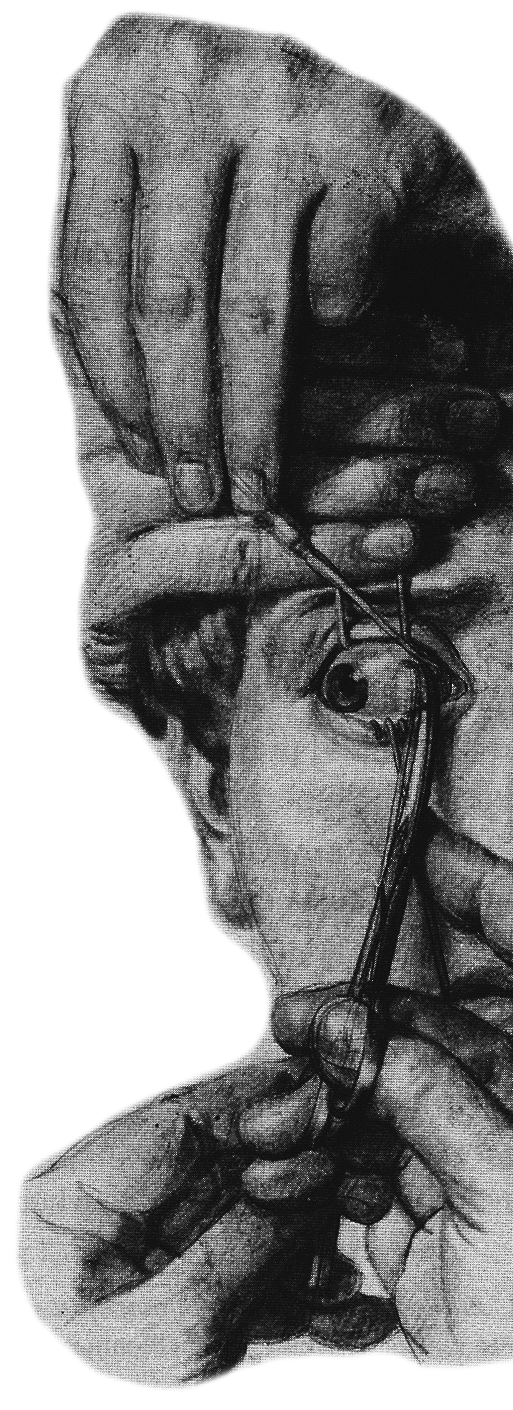
Goethe’s instruction to seal the hole announces a disordering and negation of the camera obscura as both an optical system and epistemological principle. The closing off of the opening dissolves the distinction between inner and outer space on which the very functioning of the camera (as paradig mand apparatus) depended. But it is now not simply a question of an observerrer positioned in a sealed interior to view its particular contents; the optical experience described hereby Goethe presents a notion of vision which the classical model was incapable of encompassing. The colored circles that seem to float, undulate, and undergo a sequence of chromatic transformation have no correlative either within or without the dark room; as Goethe explains at length, they are “physiological colors” belonging entirely to the body of the observer, and they are “the necessary conditions of vision.”
Let the observer look stead fastly on a small colored object and let it be taken away after a time while his eyes remain unmoved; the spectrum of another color will then be visible on the white plane . . . it arises from an image which now belongs to the eye. 4
The corporal subjectivity of the observer, which was a priori excluded from the camera obscura, suddenly becomes the site on which an observer is possible. The human body, in all its contingency and specificity generates ”the spectrum of another color,” and thus becomes the active producer of optical experience. The ramification of Goethe’s color theory are manifold and have little to do with the empirical ”truth”of his assertions or the ”scientific” character of his experiments. Contained within the unsystematized accumulation of statements and findings is a key delineation of subjective vision, a post-Kantian notion that is both a product and constituent of modernity. What is crucial about Goethe’s
account of subjective vision is the inseparability of two models usually presented as distinct and irreconcilable: a physiological subject who will be described in increasing detail by the empirical sciences in the nineteenth century, and an observer posited by various ”romanticisms” and early modernisms as the active, autonomous producer of his or her own content. This essay seeks to describe some of the features of this new kind of observer and to suggest how his or her formation in the nineteenth century was immanent to the elaboration of new empirical knowledge of vision and techniques of the visible.
1. JohannWolfgangvon Goethe, TheoryofColours,trans.Charles Eastlake,Cambridge,Mass., MIT Press, 1970, pp. 16- 17; Gedenkausgabeder Werke,Briefe,und Gesprdchee,d. Ernst Beutler, Zurich, 1949, vol. 16, pp. 35-36.
2. The presentessay is adapted froma book forthcomingfromthe MIT Press on the makingof the observer in the nineteenthcenturyin which I discuss the paradigm of the camera obscura at length. I argue that the camera obscura must be understood as part of a larger organization of JONATHAN representation, cognition, andsubjectivity inthese venteen than eighteenth centuries (common to all of Europe, not just the North as some have suggested) which is fundamentally discontinuous with a observer. Thus I contend that the camera obscura and as historic nineteenth-century photography,
cal are dissimilar.See Vision,” in Vision and Discussion in objects, radically my”Modernizing Visuality: Contemporar Cyulture, ed. Hal Foster,Seattle,Bay Press, 1988.
3. Goethe, TheoryofColours,p. 17. (Emphasisadded.)
4. Ibid.,p. 21. (Emphasisadded.) See Ernst Cassirer, Rousseau, Kant, and Goethe, trans. James Gutmann, Princeton, Princeton University Press,1945,pp.81-82: In his color theory Goethe aimed “to include nothing but the world of the eye, which containsonly form and color.”
After Images
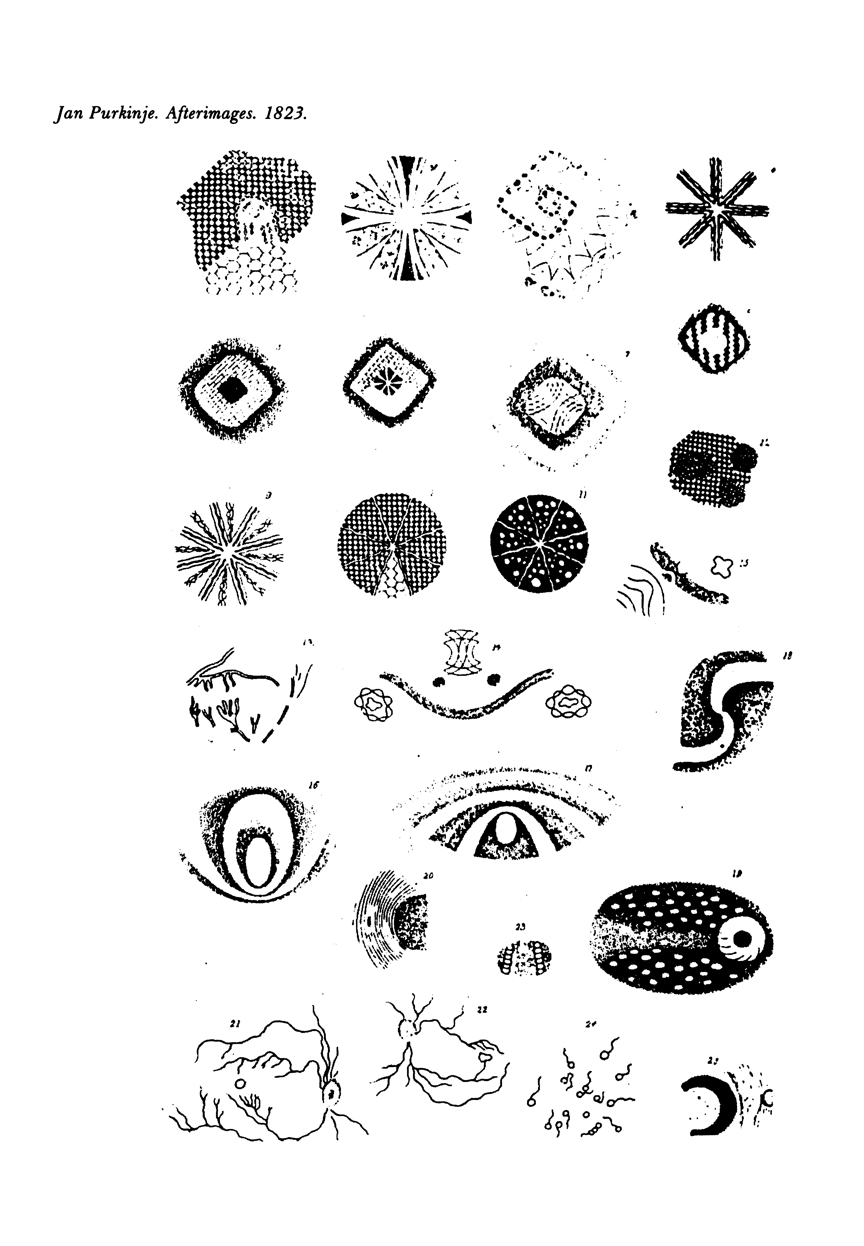
The retinal afterimage is perhaps the most important optical phenomenon discussed by Goethe in his chapter on “Physiological Colors” in his Color Theory. Though preceded by others in the late eighteenth century, his treatment of the topic was by far the most thorough up to that moment.’8 Subjective visual phenomena such as after images had been recorded since antiquity, but only as events outside the domain of optics, and they were relegated to the category of the “spectral” or mere appearance. But in the early nineteenth century, particularly with Goethe, such experiences attain the status of optical ”truth.” They are no longer deceptions that obscure a “true” perception; rather they begin to constitute an irreducible component of human vision.For Goethe and the physiologists who followed him there was no such thing as optical illusion: whatever the healthy corporal eye experienced was in fact optical truth. The implications of the new ”objectivity” accorded to subjective phenomena are several. First, the privileging of the afterimage allowed the thought of sensory perception cut from any necessary link with an external referent.The afterimage the presence of sensation in the absence of a stimulus- and its subsequent modulations posed a theoretical and empirical demonstration of autonomous vision, of an optical experience that was produced by and within the subject. Secondly, and equally crucial for the rest of the nineteenth century, is the introduction of temporality as an inescapable component of observation.’9 Most of the phenomena described by Goethe in the Color Theory involve an unfolding over time: “the edge begins to be blue . . . the blue gradually en-croaches inward. . . the image then becomes gradually fainter.” 20
What is of immediate concern here is how some of the optical devices that
spawned a new mass visual culture in the nineteenth century are inseparable from the new normative sciences of the observer and of the seeing body. The comprehensive articulation of subjective vision, which included the conceptual severing of visual experience from referent (in MUiller’s famous theory of specific
nerve and the and of of of energies), quantification study afterimages, persistence vision, peripheral and binocular vision, and thresholds of attention all were directly part of the creation of a new vast domain of visual culture.On one hand there is a new abstraction and mobility of images, on the other is an inverse disciplining of the observer in terms of rigidly fixed relations to image and apparatus, particularly with the stereoscope, the kaleidoscope, the phenakisti- scope, and even the diorama.
Beginning in the mid-1820s, the experimental study of after images was intertwined with the invention of a number of related optical devices and techniques. The boundary separating the iruse for purposes of scientific observation
and as forms of popular entertainment is indistinct. Common to the mall was the notion that perception was not instantaneous, and the notion of a disjunction between eye and object. Research on after images had suggested that some form of blending or fusion occurred when sensations were perceived in quick succession, and it was the duration involved in seeing that allowed its modification and regulation.The control of time becomes synonymous with new modalities of
power.The details and background of these devices and inventors have been well documented and discussed at length elsewhere, but almost exclusively in the service of a history of cinema.”5 Film scholars position them as the initial forms in
an evolutionary technological development leading to the emergence of a single dominant format the end of the century. Their fundamental characteristic is
prematurity; they are not- yet cinema, thus nascent and incomplete forms. Obviously there is a connection between cinema and these machinesof the 1830s,
but it is often a dialectical relation of inversion and opposition in which features of these earlier devices were negated or concealed.
18. Goethe identifiessome of these earlier researchers,includingRobert W. Darwin (1766- 1848), the fatherof Charles, and the French naturalistBuffon(1707-1788). See TheoryofColours, pp. 1- 2. See also E. G. Boring,A HistoryofExperimentaPlsychologyN,ew York, Appleton-Century-Crofts,1950, pp. 102-104.
19. science “the idea of a whichendures whichis Nineteenth-century suggested reality inwardly, durationitself”(Henri Bergson,CreativeEvolution,trans.ArthurMitchell,New York,Random House, 1944, p. 395).
20. Goethe,TheoryofColours,pp. 16- 17.
35. See, forexample,C. W. Ceram,ArchaeologoyftheCinema,New York,Harcourt,Brace and World, 1965; Michael Chanan, The Dream thatKicks:The Prehistoraynd Early YearsofCinemain
Britain,London,RoutledgeandKeganPaul,1980,esp.pp.54-65; Jean-LouisComolli,”Technique et ideologie,” Cahiersdu cinema,no. 229 (May-June1971), pp. 4- 21; Jean Mitry,Histoiredu cinema,
vol. 1, Paris, Editions Universitaires,1967, pp. 21-27; and Georges Sadoul, Histoiregeneraledu cinema,vol. 1, Paris, Denoel, 1973, pp. 15-43. See also the briefgeneaology in Gilles Deleuze,
Cinema1: The trans. Tomlinsonand Barbara Uni- Movement-Image, Hugh Habberjam, Minneapolis, versityofMinnesotaPress,1986, p. 5.
Thaumatropes
At the same time there is a tendency to conflate all optical devices in the nineteenth century as equally implicated in a vague collective drive to higher and higher standards of verisimilitude. Such teleological approaches most often neglect entirely how these devices were expressions of non veridical models of perception.
One of the earliest was the Thaumatrope (literally”,wonder-turner”), first demonstrated in London by Dr. John Paris in 1825. It was a small circular disc with a drawing on either side and strings attached so that it could be twirled with a spin of the hand. The image of a bird on one side and an empty cage on the other would produce when spun the appearance of the bird in the cage. The simplicity of this”philosophical toy”made unequivocally clear the hallucinatory and fabricated nature of the image and the absolute rupture between perception and its object.

Feraday Wheel
Also in 1825, Peter Mark Roget, an English mathematician and the author of the first Thesaurus, published an account of his observations of railway train wheels seen through the vertical barsofa fence. Roget pointed out the illusions that occurred under these circumstances in which the spokes of the wheels seemed to be either motionless or to be turning backwards. Roget’s observations suggested to him how the location of an observer in relation to an intervening screen could exploit the durational properties of retinal afterimages to create various effects of motion.The physicist Michael Faraday explored similar phenomena, particularly the experience of rapidly turning wheels that appeared to be moving slowly. In 1831, the year of his discovery of electromagnetic induction, he produced his own device, later called the Faraday wheel, consisting of two spoked wheels mounted on the same axis. By varying the relation between the spokes of the two wheels relative to the eye of the viewer, the apparent motion of the farther wheel could be modulated.Thus the experience of temporality itself is made susceptible to a range of external technical manipulations.
Phenakistiscope
During the late 1820s the Belgian scientistJosephPlateau also conducted a
wide range of experiments with afterimages, ome of which cost him his eye sight due to staring directly into the sun for extended periods.By 1828 he had worked
with a Newton color wheel, demonstrating that the duration and quality of retinal afterimage varied with the intensity color, time, and direction of the
stimulus. He also made a rough calculation of the average time that such sensations lasted- about a third of a second. What is more, his research seemed to
confirm the earlier speculations of Goethe and others that retinal afterimages do not but a number of and simply dissipateuniformly, go through positive negative
states before vanishing.He made one of the most influential formulations of the theory of “persistence of vision.”
If several objects which differse quentially in terms off orm and position are presented one after the other to the eye in very brief intervals and close the on the sufficiently together, impressions they produce retina will blend together without confusion and one will believe that a single object is gradually changing form and position. 36
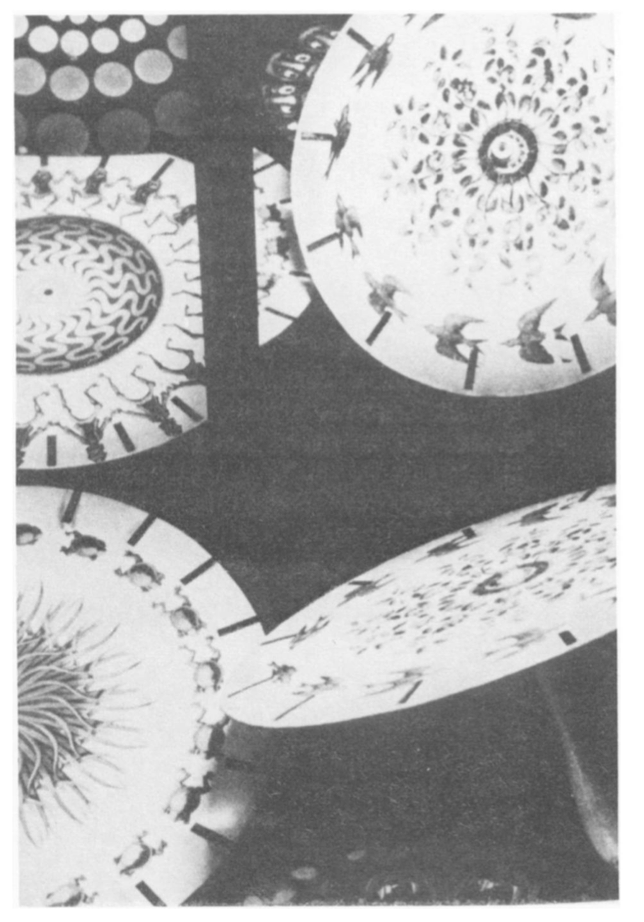
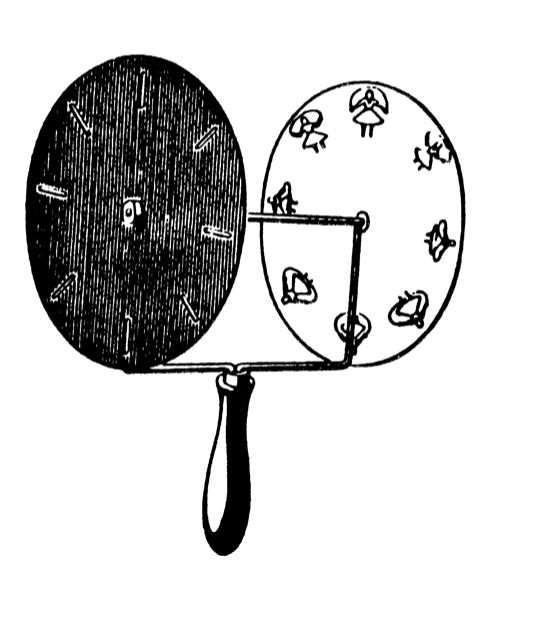
In the early 1830s, Plateau constructed the Phenakistiscope (literally”deceptive view”) which incorporated his own research and that of Roget, Faraday, and others. At its simplest it consisted of a single disc, divided into sixteen equal segments, each of which contained a small, slitted opening and a figure representing one position in a sequence of movement.The side with figures drawn on it was faced to ward a mirror while the viewer stayed immobile as the discturned. When an opening passed in front of the eye, it allowed one to see the reflected figure on the disc very briefly. The same effect occurs with each of the slits.The images then appear to be in continuous motion before the eye. By 1833, commercial models were being sold in London; by 1834 two similar devices appeared, the Stroboscope invented by the German mathematician Stampfer and the Zootrope or “wheel of life” of William G. Horner. The empirical truth of the notion of “persistence of vision” as an explana- tion for the illusion of motion is irrelevant here.” 37
36. Plateau, Dissertationsur des the sissubmitte dat Joseph quelquesproprie’is impressions, Liege,
May 1829. Quoted in Georges Sadoul, Histoiregene’raledu cinema,p. 25. 37. Some recent studies have discussed the “myth” of persistenceof vision. They tell us, not surprisingly that current neuro physiological research shows nineteenth-centuryexplanationsof
fusionor blendingof images to be an inadequate explanation forthe perception of illusorymove- ment.See Josephand Barbara Anderson,”Motion Perceptionin Motion Pictures,”and Bill Nichols
andSusanJ.Lederman,”Flicker and MotioninFilm,”both inThe Cinemati Acpparatus,ed.Teresa de Lauretis and StephenHeath, London, Macmillan,1980, pp. 76-95 and 96-105.