LETTER I.
INTRODUCTORY OBSERVATIONS.
[9]
"Ye sacred Muses, with whose beauty fired,My soul is ravished, and my brain inspired,Whose priest I am, whose holy fillets wear;Would you your poet's first petition hear,Give me the ways of wandering stars to know,The depths of heaven above, and earth below;Teach me the various labors of the moon,And whence proceed th' eclipses of the sun;Why flowing tides prevail upon the main,And in what dark recess they shrink again;What shakes the solid earth, what cause delaysThe Summer nights, and shortens Winter days."
Dryden's Virgil
To Mrs. C——M——.
Dear Madam,—In the conversation we recently held on the study of Astronomy, you expressed a strong desire to become better acquainted with this noble science, but said you had always been repelled by the air of severity which it exhibits, arrayed as it is in so many technical terms, and such abstruse mathematical processes: or, if you had taken up some smaller treatise, with the hope of avoiding these perplexities, you had always found it so meager and superficial, as to afford you very little satisfaction. You asked, if a work might not be prepared, which would convey to the general reader some clear and adequate knowledge of the great discoveries in astronomy, and yet require for its perusal no greater preparation, than may be presumed of every well-educated English scholar of either sex.
You were pleased to add the request, that I would[10] write such a work,—a work which should combine, with a luminous exposition of the leading truths of the science, some account of the interesting historical facts with which it is said the records of astronomical discovery abound. Having, moreover, heard much of the grand discoveries which, within the last fifty years, have been made among the fixed stars, you expressed a strong desire to learn more respecting these sublime researches. Finally, you desired to see the argument for the existence and natural attributes of the Deity, as furnished by astronomy, more fully and clearly exhibited, than is done in any work which you have hitherto perused. In the preparation of the proposed treatise, you urged me to supply, either in the text or in notes, every elementary principle which would be essential to a perfect understanding of the work; for although, while at school, you had paid some attention to geometry and natural philosophy, yet so much time had since elapsed, that your memory required to be refreshed on the most simple principles of these elementary studies, and you preferred that I should consider you as altogether unacquainted with them.
Although, to satisfy a mind, so cultivated and inquisitive as yours, may require a greater variety of powers and attainments than I possess, yet, as you were pleased to urge me to the trial, I have resolved to make the attempt, and will see how far I may be able to lead you into the interior of this beautiful temple, without obliging you to force your way through the "jargon of the schools."
Astronomy, however, is a very difficult or a comparatively easy study, according to the view we take of it. The investigation of the great laws which govern the motions of the heavenly bodies has commanded the highest efforts of the human mind; but profound truths, which it required the mightiest efforts of the intellect to disclose, are often, when once discovered, simple in their complexion, and may be expressed in very simple terms. Thus, the creation of that element, on whose mysteri[11]ous agency depend all the forms of beauty and loveliness, is enunciated in these few monosyllables, "And God said, let there be light, and there was light;" and the doctrine of universal gravitation, which is the key that unlocks the mysteries of the universe, is simply this,—that every portion of matter in the universe tends towards every other. The three great laws of motion, also, are, when stated, so plain, that they seem hardly to assert any thing but what we knew before. That all bodies, if at rest, will continue so, as is declared by the first law of motion, until some force moves them; or, if in motion, will continue so, until some force stops them, appears so much a matter of course, that we can at first hardly see any good reason why it should be dignified with the title of the first great law of motion; and yet it contains a truth which it required profound sagacity to discover and expound.
It is, therefore, a pleasing consideration to those who have not either the leisure of the ability to follow the astronomer through the intricate and laborious processes, which conducted him to his great discoveries, that they may fully avail themselves of the results of this vast toil, and easily understand truths which it required ages of the severest labor to unfold. The descriptive parts of astronomy, or what may be called the natural history of the heavens, is still more easily understood than the laws of the celestial motions. The revelations of the telescope, and the wonders it has disclosed in the sun, in the moon, in the planets, and especially in the fixed stars, are facts not difficult to be understood, although they may affect the mind with astonishment.
The great practical purpose of astronomy to the world is, enabling us safely to navigate the ocean. There are indeed many other benefits which it confers on man; but this is the most important. If, however, you ask, what advantages the study of astronomy promises, as a branch of education, I answer, that few subjects promise to the mind so much profit and entertainment. It is agreed by writers on the human[12] mind, that the intellectual powers are enlarged and strengthened by the habitual contemplation of great objects, while they are contracted and weakened by being constantly employed upon little or trifling subjects. The former elevate, the latter depress, the mind, to their own level. Now, every thing in astronomy is great. The magnitudes, distances, and motions, of the heavenly bodies; the amplitude of the firmament itself; and the magnificence of the orbs with which it is lighted, supply exhaustless materials for contemplation, and stimulate the mind to its noblest efforts. The emotion felt by the astronomer is not that sudden excitement or ecstasy, which wears out life, but it is a continued glow of exalted feeling, which gives the sensation of breathing in a purer atmosphere than others enjoy. We should at first imagine, that a study which calls upon its votaries for the severest efforts of the human intellect, which demands the undivided toil of years, and which robs the night of its accustomed hours of repose, would abridge the period of life; but it is a singular fact, that distinguished astronomers, as a class, have been remarkable for longevity. I know not how to account for this fact, unless we suppose that the study of astronomy itself has something inherent in it, which sustains its votaries by a peculiar aliment.
It is the privilege of the student of this department of Nature, that his cabinet is already collected, and is ever before him; and he is exempted from the toil of collecting his materials of study and illustration, by traversing land and sea, or by penetrating into the depths of the earth. Nor are they in their nature frail and perishable. No sooner is the veil of clouds removed, that occasionally conceals the firmament by night, than his specimens are displayed to view, bright and changeless. The renewed pleasure which he feels, at every new survey of the constellations, grows into an affection for objects which have so often ministered to his happiness. His imagination aids him in giving them a personification, like that which the ancients gave to the[13] constellations; (as is evident from the names which they have transmitted to us;) and he walks abroad, beneath the evening canopy, with the conscious satisfaction and delight of being in the presence of old friends. This emotion becomes stronger when he wanders far from home. Other objects of his attachment desert him; the face of society changes; the earth presents new features; but the same sun illumines the day, the same moon adorns the night, and the same bright stars still attend him.
When, moreover, the student of the heavens can command the aid of telescopes, of higher and higher powers, new acquaintances are made every evening. The sight of each new member of the starry train, that the telescope successively reveals to him, inspires a peculiar emotion of pleasure; and he at length finds himself, whenever he sweeps his telescope over the firmament, greeted by smiles, unperceived and unknown to his fellow-mortals. The same personification is given to these objects as to the constellations, and he seems to himself, at times, when he has penetrated into the remotest depths of ether, to enjoy the high prerogative of holding converse with the celestials.
It is no small encouragement, to one who wishes to acquire a knowledge of the heavens, that the subject is embarrassed with far less that is technical than most other branches of natural history. Having first learned a few definitions, and the principal circles into which, for convenience, the sphere is divided, and receiving the great laws of astronomy on the authority of the eminent persons who have investigated them, you will find few hard terms, or technical distinctions, to repel or perplex you; and you will, I hope, find that nothing but an intelligent mind and fixed attention are requisite for perusing the Letters which I propose to address to you. I shall indeed be greatly disappointed, if the perusal does not inspire you with some portion of that pleasure, which I have described as enjoyed by the astronomer himself.[14]
The dignity of the study of the heavenly bodies, and its suitableness to the most refined and cultivated mind, has been recognised in all ages. Virgil celebrates it in the beautiful strains with which I have headed this Letter, and similar sentiments have ever been cherished by the greatest minds.
As, in the course of these Letters, I propose to trace an outline of the history of astronomy, from the earliest ages to the present time, you may think this the most suitable place for introducing it; but the successive discoveries in the science cannot be fully understood and appreciated, until after an acquaintance has been formed with the science itself. We must therefore reserve the details of this subject for a future opportunity; but it may be stated, here, that astronomy was cultivated the earliest of all the sciences; that great attention was paid to it by several very ancient nations, as the Egyptians and Chaldeans, and the people of India and China, before it took its rise in Greece. More than six hundred years before the Christian era, however, it began to be studied in this latter country. Thales and Pythagoras were particularly distinguished for their devotion to this science; and the celebrated school of Alexandria, in Egypt, which took its rise about three hundred years before the Christian era, and flourished for several hundred years, numbered among its disciples a succession of eminent astronomers, among whom were Hipparchus, Eratosthenes, and Ptolemy. The last of these composed a great work on astronomy, called the 'Almagest,' in which is transmitted to us an account of all that was known of the science by the Alexandrian school. The 'Almagest' was the principal text-book in astronomy, for many centuries afterwards, and comparatively few improvements were made until the age of Copernicus. Copernicus was born at Thorn, in Prussia, in 1473. Previous to his time, the doctrine was held, that the earth is at rest in the centre of the universe, and that the sun, moon, and stars, revolve about it, every day, from east to west; in short, that[15] the apparent motions of the heavenly bodies are the same with their real motions. But Copernicus expounded what is now known to be the true theory of the celestial motions, in which the sun is placed in the centre of the solar system, and the earth and all the planets are made to revolve around him, from west to east, while the apparent diurnal motion of the heavenly bodies, from east to west, is explained by the revolution of the earth on its axis, in the same time, from west to east; a motion of which we are unconscious, and which we erroneously ascribe to external objects, as we imagine the shore is receding from us, when we are unconscious of the motion of the ship that carries us from it.
Although many of the appearances, presented by the motions of the heavenly bodies, may be explained on the former erroneous hypothesis, yet, like other hypotheses founded in error, it was continually leading its votaries into difficulties, and blinding their minds to the perception of truth. They had advanced nearly as far as it was practicable to go in the wrong road; and the great and sublime discoveries of modern times are owing, in no small degree, to the fact, that, since the days of Copernicus, astronomers have been pursuing the plain and simple path of truth, instead of threading their way through the mazes of error.
Near the close of the sixteenth century, Tycho Brahe, a native of Sweden, but a resident of Denmark, carried astronomical observations (which constitute the basis of all that is valuable in astronomy) to a far greater degree of perfection than had ever been done before. Kepler, a native of Germany, one of the greatest geniuses the world has ever seen, was contemporary with Tycho Brahe, and was associated with him in a part of his labors. Galileo, an Italian astronomer of great eminence, flourished only a little later than Tycho Brahe. He invented the telescope, and, both by his discoveries and reasonings, contributed greatly to establish the true system of the world. Soon after the commencement of the seventeenth century, (1620,) Lord[16] Bacon, a celebrated English philosopher, pointed out the true method of conducting all inquiries into the phenomena of Nature, and introduced the inductive method of philosophizing. According to the inductive method, we are to begin our inquiries into the causes of any events by first examining and classifying all the facts that relate to it, and, from the comparison of these, to deduce our conclusions.
But the greatest single discovery, that has ever been made in astronomy, was the law of universal gravitation, a discovery made by Sir Isaac Newton, in the latter part of the seventeenth century. The discovery of this law made us acquainted with the hidden forces that move the great machinery of the universe. It furnished the key which unlocks the inner temple of Nature; and from this time we may regard astronomy as fixed on a sure and immovable basis. I shall hereafter endeavor to explain to you the leading principles of universal gravitation, when we come to the proper place for inquiring into the causes of the celestial motions, as exemplified in the motion of the earth around the sun.
LETTER II.
DOCTRINE OF THE SPHERE.
"All are but parts of one stupendous whole,Whose body Nature is, and God the soul."—Pope.
Let us now consider what astronomy is, and into what great divisions it is distributed; and then we will take a cursory view of the doctrine of the sphere. This subject will probably be less interesting to you than many that are to follow; but still, permit me to urge upon you the necessity of studying it with attention, and reflecting upon each definition, until you fully understand it; for, unless you fully and clearly comprehend the circles of the sphere, and the use that is made[17] of them in astronomy, a mist will hang over every subsequent portion of the science. I beg you, therefore, to pause upon every paragraph of this Letter; and if there is any point in the whole which you cannot clearly understand, I would advise you to mark it, and to recur to it repeatedly; and, if you finally cannot obtain a clear idea of it yourself, I would recommend to you to apply for aid to some of your friends, who may be able to assist you.
Astronomy is that science which treats of the heavenly bodies. More particularly, its object is to teach what is known respecting the sun, moon, planets, comets, and fixed stars; and also to explain the methods by which this knowledge is acquired. Astronomy is sometimes divided into descriptive, physical, and practical. Descriptive astronomy respects facts; physical astronomy, causes; practical astronomy, the means of investigating the facts, whether by instruments or by calculation. It is the province of descriptive astronomy to observe, classify, and record, all the phenomena of the heavenly bodies, whether pertaining to those bodies individually, or resulting from their motions and mutual relations. It is the part of physical astronomy to explain the causes of these phenomena, by investigating the general laws on which they depend; especially, by tracing out all the consequences of the law of universal gravitation. Practical astronomy lends its aid to both the other departments.
The definitions of the different lines, points, and circles, which are used in astronomy, and the propositions founded upon them, compose the doctrine of the sphere. Before these definitions are given, I must recall to your recollection a few particulars respecting the method of measuring angles. (See Fig. 1, page 18.)
A line drawn from the centre to the circumference of a circle is called a radius, as C D, C B, or C K.
Any part of the circumference of a circle is called an arc, as A B, or B D.
An angle is measured by an arc included between[18] two radii. Thus, in Fig. 1, the angle contained between the two radii, C A and C B, that is, the angle A C B, is measured by the arc A B. Every circle, it will be recollected, is divided into three hundred and sixty equal parts, called degrees; and any arc, as A B, contains a certain number of degrees, according to its length. Thus, if the arc A B contains forty degrees, then the opposite angle A C B is said to be an angle of forty degrees, and to be measured by A B. But this arc is the same part of the smaller circle that E F is of the greater. The arc A B, therefore, contains the same number of degrees as the arc E F, and either may be taken as the measure of the angle A C B. As the whole circle contains three hundred and sixty degrees, it is evident, that the quarter of a circle, or quadrant, contains ninety degrees, and that the semicircle A B D G contains one hundred and eighty degrees.
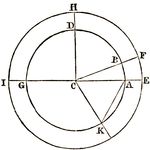 Fig. 1.
The complement of an arc, or angle, is what it wants of ninety degrees. Thus, since A D is an arc of ninety degrees, B D is the complement of A B, and A B is the complement of B D. If A B denotes a certain number of degrees of latitude, B D will be the complement of the latitude, or the colatitude, as it is commonly written.
The supplement of an arc, or angle, is what it wants of one hundred and eighty degrees. Thus, B A is the supplement of G D B, and G D B is the supplement of B A. If B A were twenty degrees of longitude, G D B, its supplement, would be one hundred and sixty degrees. An angle is said to be subtended by the side which is opposite to it. Thus, in the triangle A C K, the angle at C is subtended by the side A K, the angle at A by C K, and the angle at K by C A. In like man[19]ner, a side is said to be subtended by an angle, as A K by the angle at C.
Let us now proceed with the doctrine of the sphere.
A section of a sphere, by a plane cutting it in any manner, is a circle. Great circles are those which pass through the centre of the sphere, and divide it into two equal hemispheres. Small circles are such as do not pass through the centre, but divide the sphere into two unequal parts. The axis of a circle is a straight line passing through its centre at right angles to its plane. The pole of a great circle is the point on the sphere where its axis cuts through the sphere. Every great circle has two poles, each of which is every where ninety degrees from the great circle. All great circles of the sphere cut each other in two points diametrically opposite, and consequently their points of section are one hundred and eighty degrees apart. A great circle, which passes through the pole of another great circle, cuts the latter at right angles. The great circle which passes through the pole of another great circle, and is at right angles to it, is called a secondary to that circle. The angle made by two great circles on the surface of the sphere is measured by an arc of another great circle, of which the angular point is the pole, being the arc of that great circle intercepted between those two circles.
In order to fix the position of any place, either on the surface of the earth or in the heavens, both the earth and the heavens are conceived to be divided into separate portions, by circles, which are imagined to cut through them, in various ways. The earth thus intersected is called the terrestrial, and the heavens the celestial, sphere. We must bear in mind, that these circles have no existence in Nature, but are mere landmarks, artificially contrived for convenience of reference. On account of the immense distances of the heavenly bodies, they appear to us, wherever we are placed, to be fixed in the same concave surface, or celestial vault. The great circles of the globe, extended[20] every way to meet the concave sphere of the heavens, become circles of the celestial sphere.
The horizon is the great circle which divides the earth into upper and lower hemispheres, and separates the visible heavens from the invisible. This is the rational horizon. The sensible horizon is a circle touching the earth at the place of the spectator, and is bounded by the line in which the earth and skies seem to meet. The sensible horizon is parallel to the rational, but is distant from it by the semidiameter of the earth, or nearly four thousand miles. Still, so vast is the distance of the starry sphere, that both these planes appear to cut the sphere in the same line; so that we see the same hemisphere of stars that we should see, if the upper half of the earth were removed, and we stood on the rational horizon.
The poles of the horizon are the zenith and nadir. The zenith is the point directly over our heads; and the nadir, that directly under our feet. The plumb-line (such as is formed by suspending a bullet by a string) is in the axis of the horizon, and consequently directed towards its poles. Every place on the surface of the earth has its own horizon; and the traveller has a new horizon at every step, always extending ninety degrees from him, in all directions.
Vertical circles are those which pass through the poles of the horizon, (the zenith and nadir,) perpendicular to it.
The meridian is that vertical circle which passes through the north and south points.
The prime vertical is that vertical circle which passes through the east and west points.
The altitude of a body is its elevation above the horizon, measured on a vertical circle.
The azimuth of a body is its distance, measured on the horizon, from the meridian to a vertical circle passing through that body.
The amplitude of a body is its distance, on the horizon, from the prime vertical to a vertical circle passing through the body.[21]
Azimuth is reckoned ninety degrees from either the north or south point; and amplitude ninety degrees from either the east or west point. Azimuth and amplitude are mutually complements of each other, for one makes up what the other wants of ninety degrees. When a point is on the horizon, it is only necessary to count the number of degrees of the horizon between that point and the meridian, in order to find its azimuth; but if the point is above the horizon, then its azimuth is estimated by passing a vertical circle through it, and reckoning the azimuth from the point where this circle cuts the horizon.
The zenith distance of a body is measured on a vertical circle passing through that body. It is the complement of the altitude.
The axis of the earth is the diameter on which the earth is conceived to turn in its diurnal revolution. The same line, continued until it meets the starry concave, constitutes the axis of the celestial sphere.
The poles of the earth are the extremities of the earth's axis: the poles of the heavens, the extremities of the celestial axis.
The equator is a great circle cutting the axis of the earth at right angles. Hence, the axis of the earth is the axis of the equator, and its poles are the poles of the equator. The intersection of the plane of the equator with the surface of the earth constitutes the terrestrial, and its intersection with the concave sphere of the heavens, the celestial, equator. The latter, by way of distinction, is sometimes denominated the equinoctial.
The secondaries to the equator,—that is, the great circles passing through the poles of the equator,—are called meridians, because that secondary which passes through the zenith of any place is the meridian of that place, and is at right angles both to the equator and the horizon, passing, as it does, through the poles of both. These secondaries are also called hour circles because the arcs of the equator intercepted between them are used as measures of time.[22]
The latitude of a place on the earth is its distance from the equator north or south. The polar distance, or angular distance from the nearest pole, is the complement of the latitude.
The longitude of a place is its distance from some standard meridian, either east or west, measured on the equator. The meridian, usually taken as the standard, is that of the Observatory of Greenwich, in London. If a place is directly on the equator, we have only to inquire, how many degrees of the equator there are between that place and the point where the meridian of Greenwich cuts the equator. If the place is north or south of the equator, then its longitude is the arc of the equator intercepted between the meridian which passes through the place and the meridian of Greenwich.
The ecliptic is a great circle, in which the earth performs its annual revolutions around the sun. It passes through the centre of the earth and the centre of the sun. It is found, by observation, that the earth does not lie with its axis at right angles to the plane of the ecliptic, so as to make the equator coincide with it, but that it is turned about twenty-three and a half degrees out of a perpendicular direction, making an angle with the plane itself of sixty-six and a half degrees. The equator, therefore, must be turned the same distance out of a coincidence with the ecliptic, the two circles making an angle with each other of twenty-three and a half degrees. It is particularly important that we should form correct ideas of the ecliptic, and of its relations to the equator, since to these two circles a great number of astronomical measurements and phenomena are referred.
The equinoctial points, or equinoxes, are the intersections of the ecliptic and equator. The time when the sun crosses the equator, in going northward, is called the vernal, and in returning southward, the autumnal, equinox. The vernal equinox occurs about the twenty-first of March, and the autumnal, about the twenty-second of September.[23]
The solstitial points are the two points of the ecliptic most distant from the equator. The times when the sun comes to them are called solstices. The Summer solstice occurs about the twenty-second of June, and the Winter solstice about the twenty-second of December. The ecliptic is divided into twelve equal parts, of thirty degrees each, called signs, which, beginning at the vernal equinox, succeed each other, in the following order:
| 1. Aries, ♈ |
7. Libra, ♎ |
| 2. Taurus, ♉ |
8. Scorpio, ♏ |
| 3. Gemini, ♊ |
9. Sagittarius, ♐ |
| 4. Cancer, ♋ |
10. Capricornus, ♑ |
| 5. Leo, ♌ |
11. Aquarius, ♒ |
| 6. Virgo, ♍ |
12. Pisces. ♓ |
The mode of reckoning on the ecliptic is by signs, degrees, minutes, and seconds. The sign is denoted either by its name or its number. Thus, one hundred degrees may be expressed either as the tenth degree of Cancer, or as 3s 10°. It will be found an advantage to repeat the signs in their proper order, until they are well fixed in the memory, and to be able to recognise each sign by its appropriate character.
Of the various meridians, two are distinguished by the name of colures. The equinoctial colure is the meridian which passes through the equinoctial points. From this meridian, right ascension and celestial longitude are reckoned, as longitude on the earth is reckoned from the meridian of Greenwich. The solstitial colure is the meridian which passes through the solstitial points.
The position of a celestial body is referred to the equator by its right ascension and declination. Right ascension is the angular distance from the vernal equinox measured on the equator. If a star is situated on the equator, then its right ascension is the number of degrees of the equator between the star and the vernal equinox. But if the star is north or south of the equator, then its right ascension is the number of degrees of[24] the equator, intercepted between the vernal equinox and that secondary to the equator which passes through the star. Declination is the distance of a body from the equator measured on a secondary to the latter. Therefore, right ascension and declination correspond to terrestrial longitude and latitude,—right ascension being reckoned from the equinoctial colure, in the same manner as longitude is reckoned from the meridian of Greenwich. On the other hand, celestial longitude and latitude are referred, not to the equator, but to the ecliptic. Celestial longitude is the distance of a body from the vernal equinox measured on the ecliptic. Celestial latitude is the distance from the ecliptic measured on a secondary to the latter. Or, more briefly, longitude is distance on the ecliptic: latitude, distance from the ecliptic. The north polar distance of a star is the complement of its declination.
Parallels of latitude are small circles parallel to the equator. They constantly diminish in size, as we go from the equator to the pole. The tropics are the parallels of latitude which pass through the solstices. The northern tropic is called the tropic of Cancer; the southern, the tropic of Capricorn. The polar circles are the parallels of latitude that pass through the poles of the ecliptic, at the distance of twenty-three and a half degrees from the poles of the earth.
The elevation of the pole of the heavens above the horizon of any place is always equal to the latitude of the place. Thus, in forty degrees of north latitude we see the north star forty degrees above the northern horizon; whereas, if we should travel southward, its elevation would grow less and less, until we reached the equator, where it would appear in the horizon. Or, if we should travel northwards, the north star would rise continually higher and higher, until, if we could reach the pole of the earth, that star would appear directly over head. The elevation of the equator above the horizon of any place is equal to the complement of the latitude. Thus, at the latitude of forty degrees[25] north, the equator is elevated fifty degrees above the southern horizon.
The earth is divided into five zones. That portion of the earth which lies between the tropics is called the torrid zone; that between the tropics and the polar circles, the temperate zones; and that between the polar circles and the poles, the frigid zones.
The zodiac is the part of the celestial sphere which lies about eight degrees on each side of the ecliptic. This portion of the heavens is thus marked off by itself, because all the planets move within it.
After endeavoring to form, from the definitions, as clear an idea as we can of the various circles of the sphere, we may next resort to an artificial globe, and see how they are severally represented there. I do not advise to begin learning the definitions from the globe; the mind is more improved, and a power of conceiving clearly how things are in Nature is more effectually acquired, by referring every thing, at first, to the grand sphere of Nature itself, and afterwards resorting to artificial representations to aid our conceptions. We can get but a very imperfect idea of a man from a profile cut in paper, unless we know the original. If we are acquainted with the individual, the profile will assist us to recall his appearance more distinctly than we can do without it. In like manner, orreries, globes, and other artificial aids, will be found very useful, in assisting us to form distinct conceptions of the relations existing between the different circles of the sphere, and of the arrangements of the heavenly bodies; but, unless we have already acquired some correct ideas of these things, by contemplating them as they are in Nature, artificial globes, and especially orreries, will be apt to mislead us.
I trust you will be able to obtain the use of a globe,[1][26] to aid you in the study of the foregoing definitions, or doctrine of the sphere; but if not, I would recommend the following easy device. To represent the earth, select a large apple, (a melon, when in season, will be found still better.) The eye and the stem of the apple will indicate the position of the two poles of the earth. Applying the thumb and finger of the left hand to the poles, and holding the apple so that the poles may be in a north and south line, turn this globe from west to east, and its motion will correspond to the diurnal movement of the earth. Pass a wire or a knitting needle through the poles, and it will represent the axis of the sphere. A circle cut around the apple, half way between the poles, will be the equator; and several other circles cut between the equator and the poles, parallel to the equator, will represent parallels of latitude; of which, two, drawn twenty-three and a half degrees from the equator, will be the tropics, and two others, at the same distance from the poles, will be the polar circles. A great circle cut through the poles, in a north and south direction, will form the meridian, and several other great circles drawn through the poles, and of course perpendicularly to the equator, will be secondaries to the equator, constituting meridians, or hour circles. A great circle cut through the centre of the earth, from one tropic to the other, would represent the plane of the ecliptic; and consequently a line cut round the apple where such a section meets the surface, will be the terrestrial ecliptic. The points where this circle meets the tropics indicate the position of the solstices; and its intersection with the equator, that of the equinoctial points.
The horizon is best represented by a circular piece of pasteboard, cut so as to fit closely to the apple, being movable upon it. When this horizon is passed through the poles, it becomes the horizon of the equator; when it is so placed as to coincide with the earth's equator, it becomes the horizon of the poles; and in every other situation it represents the horizon of a[27] place on the globe ninety degrees every way from it. Suppose we are in latitude forty degrees; then let us place our movable paper parallel to our own horizon, and elevate the pole forty degrees above it, as near as we can judge by the eye. If we cut a circle around the apple, passing through its highest part, and through the east and west points, it will represent the prime vertical.
Simple as the foregoing device is, if you will take the trouble to construct one for yourself, it will lead you to more correct views of the doctrine of the sphere, than you would be apt to obtain from the most expensive artificial globes, although there are many other useful purposes which such globes serve, for which the apple would be inadequate. When you have thus made a sphere for yourself, or, with an artificial globe before you, if you have access to one, proceed to point out on it the various arcs of azimuth and altitude, right ascension and declination, terrestrial and celestial latitude and longitude,—these last being referred to the equator on the earth, and to the ecliptic in the heavens.
When the circles of the sphere are well learned, we may advantageously employ projections of them in various illustrations. By the projection of the sphere is meant a representation of all its parts on a plane. The plane itself is called the plane of projection. Let us take any circular ring, as a wire bent into a circle, and hold it in different positions before the eye. If we hold it parallel to the face, with the whole breadth opposite to the eye, we see it as an entire circle. If we turn it a little sideways, it appears oval, or as an ellipse; and, as we continue to turn it more and more round, the ellipse grows narrower and narrower, until, when the edge is presented to the eye, we see nothing but a line. Now imagine the ring to be near a perpendicular wall, and the eye to be removed at such a distance from it, as not to distinguish any interval between the ring and the wall; then the several figures under which the ring is seen will appear to be inscribed on the wall, and we[28] shall see the ring as a circle, when perpendicular to a straight line joining the centre of the ring and the eye, or as an ellipse, when oblique to this line, or as a straight line, when its edge is towards us.
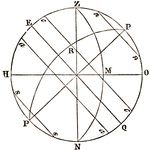 Fig. 2.
It is in this manner that the circles of the sphere are projected, as represented in the following diagram, Fig. 2. Here, various circles are represented as projected on the meridian, which is supposed to be situated directly before the eye, at some distance from it. The horizon H O, being perpendicular to the meridian, is seen edgewise, and consequently is projected into a straight line. The same is the case with the prime vertical Z N, with the equator E Q, and the several small circles parallel to the equator, which represent the two tropics and the two polar circles. In fact, all circles whatsoever, which are perpendicular to the plane of projection, will be represented by straight lines. But every circle which is perpendicular to the horizon, except the prime vertical, being seen obliquely, as Z M N, will be projected into an ellipse, one half only of which is seen,—the other half being on the other side of the plane of projection. In the same manner, P R P, an hour circle, is represented by an ellipse on the plane of projection.
LETTER III.
ASTRONOMICAL INSTRUMENTS.——TELESCOPE.
"Here truths sublime, and sacred science charm,Creative arts new faculties supply,Mechanic powers give more than giant's arm,And piercing optics more than eagle's eye;Eyes that explore creation's wondrous laws,And teach us to adore the great Designing Cause."—Beattie.
If, as I trust, you have gained a clear and familiar knowledge of the circles and divisions of the sphere, and of the mode of estimating the position of a heavenly body by its azimuth and altitude, or by its right ascension and declination, or by its longitude and latitude, you will now enter with advantage upon an account of those instruments, by means of which our knowledge of astronomy has been greatly promoted and perfected.
The most ancient astronomers employed no instruments of observation, but acquired their knowledge of the heavenly bodies by long-continued and most attentive inspection with the naked eye. Instruments for measuring angles were first used in the Alexandrian school, about three hundred years before the Christian era.
Wherever we are situated on the earth, we appear to be in the centre of a vast sphere, on the concave surface of which all celestial objects are inscribed. If we take any two points on the surface of the sphere, as two stars, for example, and imagine straight lines to be drawn to them from the eye, the angle included between these lines will be measured by the arc of the sky contained between the two points. Thus, if D B H, Fig. 3, page 30, represents the concave surface of the sphere, A, B, two points on it, as two stars, and C A, C B, straight lines drawn from the spectator to those points, then the angular distance between them is measured by the arc A B, or the angle A C B. But this an[30]gle may be measured on a much smaller circle, having the same centre, as G F K, since the arc E F will have the same number of degrees as the arc A B. The simplest mode of taking an angle between two stars is by means of an arm opening at a joint like the blade of a penknife, the end of the arm moving like C E upon the graduated circle K F G. In fact, an instrument constructed on this principle, resembling a carpenter's rule with a folding joint, with a semicircle attached, constituted the first rude apparatus for measuring the angular distance between two points on the celestial sphere. Thus the sun's elevation above the horizon might be ascertained, by placing one arm of the rule on a level with the horizon, and bringing the edge of the other into a line with the sun's centre.
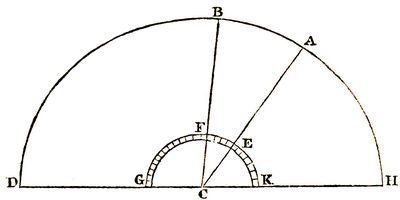 Fig. 3.
The common surveyor's compass affords a simple example of angular measurement. Here, the needle lies in a north and south line, while the circular rim of the compass, when the instrument is level, corresponds to the horizon. Hence the compass shows the azimuth of an object, or how many degrees it lies east or west of the meridian.
It is obvious, that the larger the graduated circle is, the more minutely its limb may be divided. If the circle is one foot in diameter, each degree will occupy one tenth of an inch. If the circle is twenty feet in diameter, a degree will occupy the space of two inches, and could be easily divided into minutes, since each minute would cover a space one thirtieth of an inch. Refined[31] astronomical circles are now divided with very great skill and accuracy, the spaces between the divisions being, when read off, magnified by a microscope; but in former times, astronomers had no mode of measuring small angles but by employing very large circles. But the telescope and microscope enable us at present to measure celestial arcs much more accurately than was done by the older astronomers. In the best instruments, the measurements extend to a single second of space, or one thirty-six hundredth part of a degree,—a space, on a circle twelve feet in diameter, no greater than one fifty-seven hundredth part of an inch. To divide, or graduate, astronomical instruments, to such a degree of nicety, requires the highest efforts of mechanical skill. Indeed, the whole art of instrument-making is regarded as the most difficult and refined of all the mechanical arts; and a few eminent artists, who have produced instruments of peculiar power and accuracy, take rank with astronomers of the highest celebrity.
I will endeavor to make you acquainted with several of the principal instruments employed in astronomical observations, but especially with the telescope, which is the most important and interesting of them all. I think I shall consult your wishes, as well as your improvement, by giving you a clear insight into the principles of this prince of instruments, and by reciting a few particulars, at least, respecting its invention and subsequent history.
The Telescope, as its name implies, is an instrument employed for viewing distant objects.[2] It aids the eye in two ways; first, by enlarging the visual angle under which objects are seen, and, secondly, by collecting and conveying to the eye a much larger amount of the light that emanates from the object, than would enter the naked pupil. A complete knowledge of the telescope cannot be acquired, without an acquaintance with the science of optics; but one unacquainted with that science[32] may obtain some idea of the leading principles of this noble instrument. Its main principle is as follows: By means of the telescope, we first form an image of a distant object,—as the moon, for example,—and then magnify that image by a microscope.
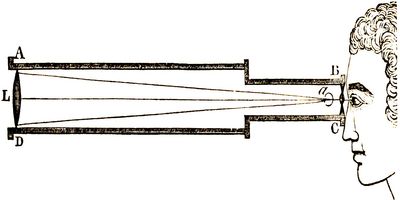 Fig. 4.
Let us first see how the image is formed. This may be done either by a convex lens, or by a concave mirror. A convex lens is a flat piece of glass, having its two faces convex, or spherical, as is seen in a common sun-glass, or a pair of spectacles. Every one who has seen a sun-glass, knows, that, when held towards the sun, it collects the solar rays into a small bright circle in the focus. This is in fact a small image of the sun. In the same manner, the image of any distant object, as a star, may be formed, as is represented in the following diagram. Let A B C D, Fig. 4, represent the tube of the telescope. At the front end, or at the end which is directed towards the object, (which we will suppose to be the moon,) is inserted a convex lens, L, which receives the rays of light from the moon, and collects them into the focus at a, forming an image of the moon. This image is viewed by a magnifier attached to the end B C. The lens, L, is called the object-glass, and the microscope in B C, the eyeglass. We apply a microscope to this image just as we would to any object; and, by greatly enlarging its dimensions, we may render its various parts far more distinct than they would otherwise be; while, at the same time, the lens collects and conveys to the eye a much greater quantity of light[33] than would proceed directly from the body under examination. A very few rays of light only, from a distant object, as a star, can enter the eye directly; but a lens one foot in diameter will collect a beam of light of the same dimensions, and convey it to the eye. By these means, many obscure celestial objects become distinctly visible, which would otherwise be either too minute, or not sufficiently luminous, to be seen by us.
But the image may also be formed by means of a concave mirror, which, as well as the concave lens, has the property of collecting the rays of light which proceed from any luminous body, and of forming an image of that body. The image formed by a concave mirror is magnified by a microscope, in the same manner as when formed by the concave lens. When the lens is used to form an image, the instrument is called a refracting telescope; when a concave mirror is used, it is called a reflecting telescope.
The office of the object-glass is simply to collect the light, and to form an image of the object, but not to magnify it: the magnifying power is wholly in the eyeglass. Hence the principle of the telescope is as follows: By means of the object-glass, (in the refracting telescope,) or by the concave mirror, (in the reflecting telescope,) we form an image of the object, and magnify that image by a microscope.
The invention of this noble instrument is generally ascribed to the great philosopher of Florence, Galileo. He had heard that a spectacle maker of Holland had accidentally hit upon a discovery, by which distant objects might be brought apparently nearer; and, without further information, he pursued the inquiry, in order to ascertain what forms and combinations of glasses would produce such a result. By a very philosophical process of reasoning, he was led to the discovery of that peculiar form of the telescope which bears his name.
Although the telescopes made by Galileo were no larger than a common spyglass of the kind now used on board of ships, yet, as they gave new views of the[34] heavenly bodies, revealing the mountains and valleys of the moon, the satellites of Jupiter, and multitudes of stars which are invisible to the naked eye, it was regarded with infinite delight and astonishment.
Reflecting telescopes were first constructed by Sir Isaac Newton, although the use of a concave reflector, instead of an object-glass, to form the image, had been previously suggested by Gregory, an eminent Scotch astronomer. The first telescope made by Newton was only six inches long. Its reflector, too, was only a little more than an inch. Notwithstanding its small dimensions, it performed so well, as to encourage further efforts; and this illustrious philosopher afterwards constructed much larger instruments, one of which, made with his own hands, was presented to the Royal Society of London, and is now carefully preserved in their library.
Newton was induced to undertake the construction of reflecting telescopes, from the belief that refracting telescopes were necessarily limited to a very small size, with only moderate illuminating powers, whereas the dimensions and powers of the former admitted of being indefinitely increased. Considerable magnifying powers might, indeed, be obtained from refractors, by making them very long; but the brightness with which telescopic objects are seen, depends greatly on the dimensions of the beam of light which is collected by the object-glass, or by the mirror, and conveyed to the eye; and therefore, small object-glasses cannot have a very high illuminating power. Now, the experiments of Newton on colors led him to believe, that it would be impossible to employ large lenses in the construction of telescopes, since such glasses would give to the images, they formed, the colors of the rainbow. But later opticians have found means of correcting these imperfections, so that we are now able to use object-glasses a foot or more in diameter, which give very clear and bright images. Such instruments are called achromatic telescopes,—a name implying the absence of prismatic or rainbow colors in the image. It is, however, far more[35] difficult to construct large achromatic than large reflecting telescopes. Very large pieces of glass can seldom be found, that are sufficiently pure for the purpose; since every inequality in the glass, such as waves, tears, threads, and the like, spoils it for optical purposes, as it distorts the light, and produces nothing but confused images.
The achromatic telescope (that is, the refracting telescope, having such an object-glass as to give a colorless image) was invented by Dollond, a distinguished English artist, about the year 1757. He had in his possession a quantity of glass of a remarkably fine quality, which enabled him to carry his invention at once to a high degree of perfection. It has ever since been, with the manufacturers of telescopes, a matter of the greatest difficulty to find pieces of glass, of a suitable quality for object-glasses, more than two or three inches in diameter. Hence, large achromatic telescopes are very expensive, being valued in proportion to the cubes of their diameters; that is, if a telescope whose aperture (as the breadth of the object-glass is technically called) is two inches, cost one hundred dollars, one whose aperture is eight inches would cost six thousand four hundred dollars.
Since it is so much easier to make large reflecting than large refracting telescopes, you may ask, why the latter are ever attempted, and why reflectors are not exclusively employed? I answer, that the achromatic telescope, when large and well constructed, is a more perfect and more durable instrument than the reflecting telescope. Much more of the light that falls on the mirror is absorbed than is lost in passing through the object-glass of a refractor; and hence the larger achromatic telescopes afford a stronger light than the reflecting, unless the latter are made of an enormous and unwieldy size. Moreover, the mirror is very liable to tarnish, and will never retain its full lustre for many years together; and it is no easy matter to restore the lustre, when once impaired.[36]
In my next Letter, I will give you an account of some of the most celebrated telescopes that have ever been constructed, and point out the method of using this excellent instrument, so as to obtain with it the finest views of the heavenly bodies.
LETTER IV
TELESCOPE CONTINUED.
——"the broad circumferenceHung on his shoulders like the moon, whose orbThrough optic glass the Tuscan artist viewsvening, from the top of FesoléOr in Valdarno, to descry new lands,Rivers or mountains, in her spotted globe."—Milton.
The two most celebrated telescopes, hitherto made, are Herschel's forty-feet reflector, and the great Dorpat refractor. Herschel was a Hanoverian by birth, but settled in England in the younger part of his life. As early as 1774, he began to make telescopes for his own use; and, during his life, he made more than four hundred, of various sizes and powers. Under the patronage of George the Third, he completed, in 1789, his great telescope, having a tube of iron, forty feet long, and a speculum, forty-nine and a half inches or more than four feet in diameter. Let us endeavor to form a just conception of this gigantic instrument, which we can do only by dwelling on its dimensions, and comparing them with those of other objects with which we are familiar, as the length or height of a house, and the breadth of a hogshead or cistern, of known dimensions. The reflector alone weighed nearly a ton. So large and ponderous an instrument must require a vast deal of machinery to work it, and to keep it steady; and, accordingly, the framework surrounding it was formed of heavy timbers, and resembled the frame of a large building. When one of the largest of the fixed stars, as Sirius, is entering the field of this telescope, its approach[37] is announced by a bright dawn, like that which precedes the rising sun; and when the star itself enters the field, the light is insupportable to the naked eye. The planets are expanded into brilliant luminaries, like the moon; and innumerable multitudes of stars are scattered like glittering dust over the celestial vault.
The great Dorpat telescope is of more recent construction. It was made by Fraunhofer, a German optician of the greatest eminence, at Munich, in Bavaria, and takes its name from its being attached to the observatory at Dorpat, in Russia. It is of much smaller dimensions than the great telescope of Herschel. Its object-glass is nine and a half inches in diameter, and its length, fourteen feet. Although the price of this instrument was nearly five thousand dollars, yet it is said that this sum barely covered the actual expenses. It weighs five thousand pounds, and yet is turned with the finger. In facility of management, it has greatly the advantage of Herschel's telescope. Moreover, the sky of England is so much of the time unfavorable for astronomical observation, that one hundred good hours (or those in which the higher powers can be used) are all that can be obtained in a whole year. On this account, and on account of the difficulty of shifting the position of the instrument, Herschel estimated that it would take about six hundred years to obtain with it even a momentary glimpse of every part of the heavens. This remark shows that such great telescopes are unsuited to the common purposes of astronomical observation. Indeed, most of Herschel's discoveries were made with his small telescopes; and although, for certain rare purposes, powers were applied which magnified seven thousand times, yet, in most of his observations, powers magnifying only two or three hundred times were employed. The highest power of the Dorpat telescope is only seven hundred, and yet the director of this instrument, Professor Struve, is of the opinion, that it is nearly or quite equal in quality, all things considered, to Herschel's forty-feet reflector.[38]
It is not generally understood in what way greatness of size in a telescope increases its powers; and it conveys but an imperfect idea of the excellence of a telescope, to tell how much it magnifies. In the same instrument, an increase of magnifying power is always attended with a diminution of the light and of the field of view. Hence, the lower powers generally afford the most agreeable views, because they give the clearest light, and take in the largest space. The several circumstances which influence the qualities of a telescope are, illuminating power, distinctness, field of view, and magnifying power. Large mirrors and large object-glasses are superior to smaller ones, because they collect a larger beam of light, and transmit it to the eye. Stars which are invisible to the naked eye are rendered visible by the telescope, because this instrument collects and conveys to the eye a large beam of the few rays which emanate from the stars; whereas a beam of these rays of only the diameter of the pupil of the eye, would afford too little light for distinct vision. In this particular, large telescopes have great advantages over small ones. The great mirror of Herschel's forty-feet reflector collects and conveys to the eye a beam more than four feet in diameter. The Dorpat telescope also transmits to the eye a beam nine and one half inches in diameter. This seems small, in comparison with the reflector; but much less of the light is lost on passing through the glass than is absorbed by the mirror, and the mirror is very liable to be clouded or tarnished; so that there is not so great a difference in the two instruments, in regard to illuminating power, as might be supposed from the difference of size.
Distinctness of view is all-important to the performance of an instrument. The object may be sufficiently bright, yet, if the image is distorted, or ill-defined, the illumination is of little consequence. This property depends mainly on the skill with which all the imperfections of figure and color in the glass or mirror are corrected, and can exist in perfection only when the[39] image is rendered completely achromatic, and when all the rays that proceed from each point in the object are collected into corresponding points of the image, unaccompanied by any other rays. Distinctness is very much affected by the steadiness of the instrument. Every one knows how indistinct a page becomes, when a book is passed rapidly backwards and forwards before the eyes, and how difficult it is to read in a carriage in rapid motion on a rough road.
Field of view is another important consideration. The finest instruments exhibit the moon, for example, not only bright and distinct, in all its parts, but they take in the whole disk at once; whereas, the inferior instruments, when the higher powers, especially, are applied, permit us to see only a small part of the moon at once.
I hope, my friend, that, when you have perused these Letters, or rather, while you are perusing them, you will have frequent opportunities of looking through a good telescope. I even anticipate that you will acquire such a taste for viewing the heavenly bodies with the aid of a good glass, that you will deem a telescope a most suitable appendage to your library, and as certainly not less an ornament to it than the more expensive statues with which some people of fortune adorn theirs. I will therefore, before concluding this letter, offer you a few directions for using the telescope.
Some states of weather, even when the sky is clear, are far more favorable for astronomical observation than others. After sudden changes of temperature in the atmosphere, the medium is usually very unsteady. If the sun shines out warm after a cloudy season, the ground first becomes heated, and the air that is nearest to it is expanded, and rises, while the colder air descends, and thus ascending and descending currents of air, mingling together, create a confused and wavy medium. The same cause operates when a current of hot air rises from a chimney; and hence the state of the atmosphere in cities and large towns is very unfavora[40]ble to the astronomer, on this account, as well as on account of the smoky condition in which it is usually found. After a long season of dry weather, also, the air becomes smoky, and unfit for observation. Indeed, foggy, misty, or smoky, air is so prevalent in some countries, that only a very few times in the whole year can be found, which are entirely suited to observation, especially with the higher powers; for we must recollect, that these inequalities and imperfections are magnified by telescopes, as well as the objects themselves. Thus, as I have already mentioned, not more than one hundred good hours in a year could be obtained for observation with Herschel's great telescope. By good hours, Herschel means that the sky must be very clear, the moon absent, no twilight, no haziness, no violent wind, and no sudden change of temperature. As a general fact, the warmer climates enjoy a much finer sky for the astronomer than the colder, having many more clear evenings, a short twilight, and less change of temperature. The watery vapor of the atmosphere, also, is more perfectly dissolved in hot than in cold air, and the more water air contains, provided it is in a state of perfect solution, the clearer it is.
A certain preparation of the observer himself is also requisite for the nicest observations with the telescope. He must be free from all agitation, and the eye must not recently have been exposed to a strong light, which contracts the pupil of the eye. Indeed, for delicate observations, the observer should remain for some time beforehand in a dark room, to let the pupil of the eye dilate. By this means, it will be enabled to admit a larger number of the rays of light. In ascending the stairs of an observatory, visitors frequently get out of breath, and having perhaps recently emerged from a strongly-lighted apartment, the eye is not in a favorable state for observation. Under these disadvantages, they take a hasty look into the telescope, and it is no wonder that disappointment usually follows.
Want of steadiness is a great difficulty attending the[41] use of the highest magnifiers; for the motions of the instrument are magnified as well as the object. Hence, in the structure of observatories, the greatest pains is requisite, to avoid all tremor, and to give to the instruments all possible steadiness; and the same care is to be exercised by observers. In the more refined observations, only one or two persons ought to be near the instrument.
In general, low powers afford better views of the heavenly bodies than very high magnifiers. It may be thought absurd, to recommend the use of low powers, in respect to large instruments especially, since it is commonly supposed that the advantage of large instruments is, that they will bear high magnifying powers. But this is not their only, nor even their principal, advantage. A good light and large field are qualities, for most purposes, more important than great magnifying power; and it must be borne in mind, that, as we increase the magnifying power in a given instrument, we diminish both the illumination and the field of view. Still, different objects require different magnifying powers; and a telescope is usually furnished with several varieties of powers, one of which is best fitted for viewing the moon, another for Jupiter, and a still higher power for Saturn. Comets require only the lowest magnifiers; for here, our object is to command as much light, and as large a field, as possible, while it avails little to increase the dimensions of the object. On the other hand, for certain double stars, (stars which appear single to the naked eye, but double to the telescope,) we require very high magnifiers, in order to separate these minute objects so far from each other, that the interval can be distinctly seen. Whenever we exhibit celestial objects to inexperienced observers, it is useful to precede the view with good drawings of the objects, accompanied by an explanation of what each appearance, exhibited in the telescope, indicates. The novice is told, that mountains and valleys can be seen in the moon by the aid of the telescope; but, on[42] looking, he sees a confused mass of light and shade, and nothing which looks to him like either mountains or valleys. Had his attention been previously directed to a plain drawing of the moon, and each particular appearance interpreted to him, he would then have looked through the telescope with intelligence and satisfaction.
LETTER V.
LETTER V.
OBSERVATORIES.
"We, though from heaven remote, to heaven will move,With strength of mind, and tread the abyss above;And penetrate, with an interior light,Those upper depths which Nature hid from sight.Pleased we will be, to walk along the sphereOf shining stars, and travel with the year."—Ovid.
An observatory is a structure fitted up expressly for astronomical observations, and furnished with suitable instruments for that purpose.
The two most celebrated observatories, hitherto built, are that of Tycho Brahe, and that of Greenwich, near London. The observatory of Tycho Brahe, Fig. 5, was constructed at the expense of the King of Denmark, in a style of royal magnificence, and cost no less than two hundred thousand crowns. It was situated on the island of Huenna, at the entrance of the Baltic, and was called Uraniburg, or the palace of the skies.
Before I give you an account of Tycho's observatory, I will recite a few particulars respecting this great astronomer himself.
[43]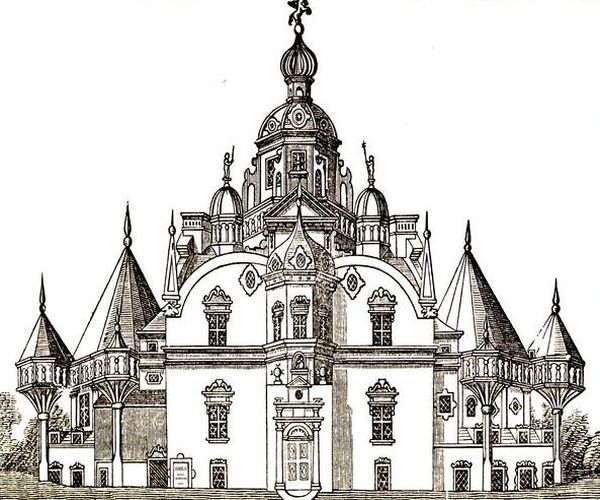 Fig. 5.
Tycho Brahe was of Swedish descent, and of noble family; but having received his education at the University of Copenhagen, and spent a large part of his life in Denmark, he is usually considered as a Dane, and quoted as a Danish astronomer. He was born in the year 1546. When he was about fourteen years old, there happened a great eclipse of the sun, which awakened in him a high interest, especially when he saw how [44]accurately all the circumstances of it answered to the prediction with which he had been before made acquainted. He was immediately seized with an irresistible passion to acquire a knowledge of the science which could so successfully lift the veil of futurity. His friends had destined him for the profession of law, and, from the superior talents of which he gave early promise, and with the advantage of powerful family connexions, they had marked out for him a distinguished career in public life. They therefore endeavored to discourage him from pursuing a path which they deemed so much less glorious than that, and vainly sought, by various means, to extinguish the zeal for astronomy which was kindled in his youthful bosom. Despising all the attractions of a court, he contracted an alliance with a peasant girl, and, in the peaceful retirement of domestic life, desired no happier lot than to peruse the grand volume which the nocturnal heavens displayed to his enthusiastic imagination. He soon established his fame as one of the greatest astronomers of the age, and monarchs did homage to his genius. The King of Denmark became his munificent patron, and James the First, King of England, when he went to Denmark to complete his marriage with a Danish Princess, passed eight days with Tycho in his observatory, and, at his departure, addressed to the astronomer a Latin ode, accompanied with a magnificent present. He gave him also his royal license to print his works in England, and added to it the following complimentary letter: "Nor am I acquainted with these things on the relation of others, or from a mere perusal of your works, but I have seen them with my own eyes, and heard them with my own ears, in your residence at Uraniburg, during the various learned and agreeable conversations which I there held with you, which even now affect my mind to such a degree, that it is difficult to decide, whether I recollect them with greater pleasure or admiration." Admiring disciples also crowded to this sanctuary of the sciences, to acquire a knowledge of the heavens.[45]
The observatory consisted of a main building, which was square, each side being sixty feet, and of large wings in the form of round towers. The whole was executed in a style of great magnificence, and Tycho, who was a nobleman by descent, gratified his taste for splendor and ornament, by giving to every part of the structure an air of the most finished elegance. Nor were the instruments with which it was furnished less magnificent than the buildings. They were vastly larger than had before been employed in the survey of the heavens, and many of them were adorned with costly ornaments. The cut on page 46, Fig. 6, represents one of Tycho's large and splendid instruments, (an astronomical quadrant,) on one side of which was figured a representation of the astronomer and his assistants, in the midst of their instruments, and intently engaged in making and recording observations. It conveys to us a striking idea of the magnificence of his arrangements, and of the extent of his operations.
Here Tycho sat in state, clad in the robes of nobility, and supported throughout his establishment the etiquette due to his rank. His observations were more numerous than all that had ever been made before, and they were carried to a degree of accuracy that is astonishing, when we consider that they were made without the use of the telescope, which was not yet invented.
Tycho carried on his observations at Uraniburg for about twenty years, during which time he accumulated an immense store of accurate and valuable facts, which afforded the groundwork of the discovery of the great laws of the solar system established by Kepler, of whom I shall tell you more hereafter.
[46]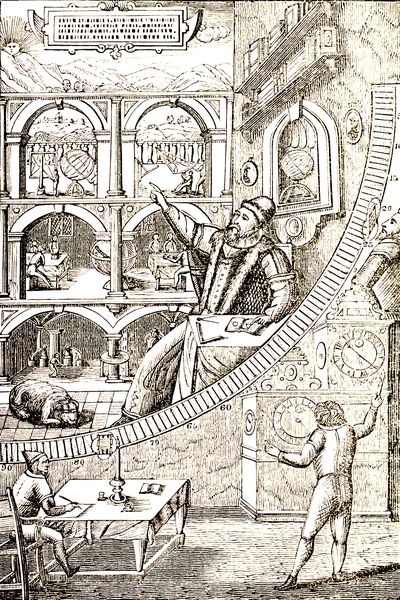 Fig. 6.
But the high marks of distinction which Tycho enjoyed, not only from his own Sovereign, but also from foreign potentates, provoked the envy of the courtiers of his royal patron. They did not indeed venture to make their attacks upon him while his generous patron was living; but the King was no sooner dead, and succeeded by a young monarch, who did not feel the same[47] interest in protecting and encouraging this great ornament of the kingdom, than his envious foes carried into execution their long-meditated plot for his ruin. They represented to the young King, that the treasury was exhausted, and that it was necessary to retrench a number of pensions, which had been granted for useless purposes, and in particular that of Tycho, which, they maintained, ought to be conferred upon some person capable of rendering greater services to the state. By these means, they succeeded in depriving him of his support, and he was compelled to retreat under the hospitable mansion of a friend in Germany. Here he became known to the Emperor, who invited him to Prague, where, with an ample stipend, he resumed his labors. But, though surrounded with affectionate friends and admiring disciples, he was still an exile in a foreign land. Although his country had been base in its ingratitude, it was yet the land which he loved; the scene of his earliest affection; the theatre of his scientific glory. These feelings continually preyed upon his mind, and his unsettled spirit was ever hovering among his native mountains. In this condition he was attacked by a disease of the most painful kind, and, though its agonizing paroxysms had lengthened intermissions, yet he saw that death was approaching. He implored his pupils to persevere in their scientific labors; he conversed with Kepler on some of the profoundest points of astronomy; and with these secular occupations he mingled frequent acts of piety and devotion. In this happy condition he expired, without pain, at the age of fifty-five.[3]
The observatory at Greenwich was not built until a hundred years after that of Tycho Brahe, namely, in 1676. The great interests of the British nation, which are involved in navigation, constituted the ruling motive with the government to lend their aid in erecting and maintaining this observatory.[48]
The site of the observatory at Greenwich is on a commanding eminence facing the River Thames, five miles east of the central parts of London. Being part of a royal park, the neighboring grounds are in no danger of being occupied by buildings, so as to obstruct the view. It is also in full view of the shipping on the Thames; and, according to a standing regulation of the observatory, at the instant of one o'clock, every day, a huge ball is dropped from over the house, as a signal to the commanders of vessels for regulating their chronometers.
The buildings comprise a series of rooms, of sufficient number and extent to accommodate the different instruments, the inmates of the establishment, and the library; and on the top is a celebrated camera obscura, exhibiting a most distinct and perfect picture of the grand and unrivalled scenery which this eminence commands.
This establishment, by the accuracy and extent of its observations, has contributed more than all other institutions to perfect the science of astronomy.
To preside over and direct this great institution, a man of the highest eminence in the science is appointed by the government, with the title of Astronomer Royal. He is paid an ample salary, with the understanding that he is to devote himself exclusively to the business of the observatory. The astronomers royal of the Greenwich observatory, from the time of its first establishment, in 1676, to the present time, have constituted a series of the proudest names of which British science can boast. A more detailed sketch of their interesting history will be given towards the close of these Letters.
Six assistants, besides inferior laborers, are constantly in attendance; and the business of making and recording observations is conducted with the utmost system and order.
The great objects to be attained in the construction of an observatory are, a commanding and unobstructed view of the heavens; freedom from causes that affect[49] the transparency and uniform state of the atmosphere, such as fires, smoke, or marshy grounds; mechanical facilities for the management of instruments, and, especially, every precaution that is necessary to secure perfect steadiness. This last consideration is one of the greatest importance, particularly in the use of very large magnifiers; for we must recollect, that any motion in the instrument is magnified by the full power of the glass, and gives a proportional unsteadiness to the object. A situation is therefore selected as remote as possible from public roads, (for even the passing of carriages would give a tremulous motion to the ground, which would be sensible in large instruments,) and structures of solid masonry are commenced deep enough in the ground to be unaffected by frost, and built up to the height required, without any connexion with the other parts of the building. Many observatories are furnished with a movable dome for a roof, capable of revolving on rollers, so that instruments penetrating through the roof may be easily brought to bear upon any point at or near the zenith.
You will not perhaps desire me to go into a minute description of all the various instruments that are used in a well-constructed observatory. Nor is this necessary, since a very large proportion of all astronomical observations are taken on the meridian, by means of the transit instrument and clock. When a body, in its diurnal revolution, comes to the meridian, it is at its highest point above the horizon, and is then least affected by refraction and parallax. This, then, is the most favorable position for taking observations upon it. Moreover, it is peculiarly easy to take observations on a body when in this situation. Hence the transit instrument and clock are the most important members of an astronomical observatory. You will, therefore, expect me to give you some account of these instruments.
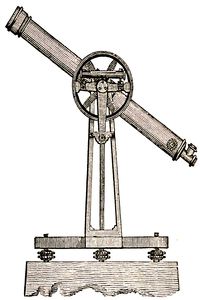 Fig. 7.
The transit instrument is a telescope which is fixed permanently in the meridian, and moves only in that plane. The accompanying diagram, Fig. 7, represents[50] a side view of a portable transit instrument, exhibiting the telescope supported on a firm horizontal axis, on which it turns in the plane of the meridian, from the south point of the horizon through the zenith to the north point. It can therefore be so directed as to observe the passage of a star across the meridian at any altitude. The accompanying graduated circle enables the observer to set the instrument at any required altitude, corresponding to the known altitude at which the body to be observed crosses the meridian. Or it may be used to measure the altitude of a body, or its zenith distance, at the time of its meridian passage. Near the circle may be seen a spirit-level, which serves to show when the axis is exactly on a level with the horizon. The framework is made of solid metal, (usually brass,) every thing being arranged with reference to keeping the instrument perfectly steady. It stands on screws, which not only afford a steady support, but are useful[51] for adjusting the instrument to a perfect level. The transit instrument is sometimes fixed immovably to a solid foundation, as a pillar of stone, which is built up from a depth in the ground below the reach of frost. When enclosed in a building, as in an observatory, the stone pillar is carried up separate from the walls and floors of the building, so as to be entirely free from the agitations to which they are liable.
The use of the transit instrument is to show the precise instant when a heavenly body is on the meridian, or to measure the time it occupies in crossing the meridian. The astronomical clock is the constant companion of the transit instrument. This clock is so regulated as to keep exact pace with the stars, and of course with the revolution of the earth on its axis; that is, it is regulated to sidereal time. It measures the progress of a star, indicating an hour for every fifteen degrees, and twenty-four hours for the whole period of the revolution of the star. Sidereal time commences when the vernal equinox is on the meridian, just as solar time commences when the sun is on the meridian. Hence the hour by the sidereal clock has no correspondence with the hour of the day, but simply indicates how long it is since the equinoctial point crossed the meridian. For example, the clock of an observatory points to three hours and twenty minutes; this may be in the morning, at noon, or any other time of the day,—for it merely shows that it is three hours and twenty minutes since the equinox was on the meridian. Hence, when a star is on the meridian, the clock itself shows its right ascension, which you will recollect is the angular distance measured on the equinoctial, from the point of intersection of the ecliptic and equinoctial, called the vernal equinox, reckoning fifteen degrees for every hour, and a proportional number of degrees and minutes for a less period. I have before remarked, that a very large portion of all astronomical observations are taken when the bodies are on the meridian, by means of the transit instrument and clock.[52]
Having now described these instruments, I will next explain the manner of using them for different observations. Any thing becomes a measure of time, which divides duration equally. The equinoctial, therefore, is peculiarly adapted to this purpose, since, in the daily revolution of the heavens, equal portions of the equinoctial pass under the meridian in equal times. The only difficulty is, to ascertain the amount of these portions for given intervals. Now, the clock shows us exactly this amount; for, when regulated to sidereal time, (as it easily may be,) the hour-hand keeps exact pace with the equator, revolving once on the dial-plate of the clock while the equator turns once by the revolution of the earth. The same is true, also, of all the small circles of diurnal revolution; they all turn exactly at the same rate as the equinoctial, and a star situated any where between the equator and the pole will move in its diurnal circle along with the clock, in the same manner as though it were in the equinoctial. Hence, if we note the interval of time between the passage of any two stars, as shown by the clock, we have a measure of the number of degrees by which they are distant from each other in right ascension. Hence we see how easy it is to take arcs of right ascension: the transit instrument shows us when a body is on the meridian; the clock indicates how long it is since the vernal equinox passed it, which is the right ascension itself; or it tells us the difference of right ascension between any two bodies, simply by indicating the difference in time between their periods of passing the meridian. Again, it is easy to take the declination of a body when on the meridian. By declination, you will recollect, is meant the distance of a heavenly body from the equinoctial; the same, indeed, as latitude on the earth. When a star is passing the meridian, if, on the instant of crossing the meridian wire of the telescope, we take its distance from the north pole, (which may readily be done, because the position of the pole is always known, being equal to the latitude of the place,) and subtract[53] this distance from ninety degrees, the remainder will be the distance from the equator, which is the declination. You will ask, why we take this indirect method of finding the declination? Why we do not rather take the distance of the star from the equinoctial, at once? I answer, that it is easy to point an instrument to the north pole, and to ascertain its exact position, and of course to measure any distance from it on the meridian, while, as there is nothing to mark the exact situation of the equinoctial, it is not so easy to take direct measurements from it. When we have thus determined the situation of a heavenly body, with respect to two great circles at right angles with each other, as in the present case, the distance of a body from the equator and from the equinoctial colure, or that meridian which passes though the vernal equinox, we know its relative position in the heavens; and when we have thus determined the relative positions of all the stars, we may lay them down on a map or a globe, exactly as we do places on the earth, by means of their latitude and longitude.
The foregoing is only a specimen of the various uses of the transit instrument, in finding the relative places of the heavenly bodies. Another use of this excellent instrument is, to regulate our clocks and watches. By an observation with the transit instrument, we find when the sun's centre is on the meridian. This is the exact time of apparent noon. But watches and clocks usually keep mean time, and therefore, in order to set our timepiece by the transit instrument, we must apply to the apparent time of noon the equation of time, as will be explained in my next Letter.
A noon-mark may easily be made by the aid of the transit instrument. A window sill is frequently selected as a suitable place for the mark, advantage being taken of the shadow projected upon it by the perpendicular casing of the window. Let an assistant stand, with a rule laid on the line of shadow, and with a knife ready to make the mark, the instant when the observer at the[54] transit instrument announces that the centre of the sun is on the meridian. By a concerted signal, as the stroke of a bell, the inhabitants of a town may all fix a noon-mark from the same observation. If the signal be given on one of the days when apparent time and mean time become equal to each other, as on the twenty-fourth of December, no equation of time is required.
As a noon-mark is convenient for regulating timepieces, I will point out a method of making one, which may be practised without the aid of the telescope. Upon a smooth, level plane, freely exposed to the sun, with a pair of compasses describe a circle. In the centre, where the leg of the compasses stood, erect a perpendicular wire of such a length, that the termination of its shadow shall fall upon the circumference of the circle at some hour before noon, as about ten o'clock. Make a small dot at the point where the end of the shadow falls upon the circle, and do the same where it falls upon it again in the afternoon. Take a point half-way between these two points, and from it draw a line to the centre, and it will be a true meridian line. The direction of this line would be the same, whether it were made in the Summer or in the Winter; but it is expedient to draw it about the fifteenth of June, for then the shadow alters its length most rapidly, and the moment of its crossing the wire will be more definite, than in the Winter. At this time of year, also, the sun and clock agree, or are together, as will be more fully explained in my next Letter; whereas, at other times of the year, the time of noon, as indicated by a common clock, would not agree with that indicated by the sun. If the upper end of the wire is flattened, and a small hole is made in it, through which the sun may shine, the instant when this bright spot falls upon the circle will be better defined than the termination of the shadow.
Another important instrument of the observatory is the mural circle. It is a graduated circle, usually of very large size, fixed permanently in the plane of the meridian, and attached firmly to a perpendicular wall;[55] and on its centre is a telescope, which revolves along with it, and is easily brought to bear on any object in any point in the meridian. It is made of large size, sometimes twenty feet in diameter, in order that very small angles may be measured on its limb; for it is obvious that a small angle, as one second, will be a larger space on the limb of an instrument, in proportion as the instrument itself is larger. The vertical circle usually connected with the transit instrument, as in Fig. 7, may indeed be employed for the same purposes as the mural circle, namely, to measure arcs of the meridian, as meridian altitudes, zenith distances, north polar distances, and declinations; but as that circle must necessarily be small, and therefore incapable of measuring very minute angles, the mural circle is particularly useful in measuring these important arcs. It is very difficult to keep so large an instrument perfectly steady; and therefore it is attached to a massive wall of solid masonry, and is hence called a mural circle, from a Latin word, (murus,) which signifies a wall.
The diagram, Fig. 8, page 56, represents a mural circle fixed to its wall, and ready for observations. It will be seen, that every expedient is employed to give the instrument firmness of parts and steadiness of position. The circle is of solid metal, usually of brass, and it is strengthened by numerous radii, which keep it from warping or bending; and these are made in the form of hollow cones, because that is the figure which unites in the highest degree lightness and strength. On the rim of the instrument, at A, you may observe a microscope. This is attached to a micrometer,—a delicate piece of apparatus, used for reading the minute subdivisions of angles; for, after dividing the limb of the instrument as minutely as possible, it will then be necessary to magnify those divisions with the microscope, and subdivide each of these parts with the micrometer. Thus, if we have a mural circle twenty feet in diameter, and of course nearly sixty-three feet in circumference, since there are twenty-one thousand and six hun[56]dred minutes in the whole circle, we shall find, by calculation, that one minute would occupy, on the limb of such an instrument, only about one thirtieth of an inch, and a second, only one eighteen hundredth of an inch. We could not, therefore, hope to carry the actual divisions to a greater degree of minuteness than minutes; but each of these spaces may again be subdivided into seconds by the micrometer.
 Fig. 8.
From these statements, you will acquire some faint idea of the extreme difficulty of making perfect astronomical instruments, especially where they are intended to measure such minute angles as one second. Indeed, the art of constructing astronomical instruments is one which requires such refined mechanical genius,—so su[57]perior a mind to devise, and so delicate a hand to execute,—that the most celebrated instrument-makers take rank with the most distinguished astronomers; supplying, as they do, the means by which only the latter are enabled to make these great discoveries. Astronomers have sometimes made their own telescopes; but they have seldom, if ever, possessed the refined manual skill which is requisite for graduating delicate instruments.
The sextant is also one of the most valuable instruments for taking celestial arcs, or the distance between any two points on the celestial sphere, being applicable to a much greater number of purposes than the instruments already described. It is particularly valuable for measuring celestial arcs at sea, because it is not, like most astronomical instruments, affected by the motion of the ship. The principle of the sextant may be briefly described, as follows: it gives the angular distance between any two bodies on the celestial sphere, by reflecting the image of one of the bodies so as to coincide with the other body, as seen directly. The arc through which the reflector is turned, to bring the reflected body to coincide with the other body, becomes a measure of the angular distance between them. By keeping this principle in view, you will be able to understand the use of the several parts of the instrument, as they are exhibited in the diagram, Fig. 9, page 58.
It is, you observe, of a triangular shape, and it is made strong and firm by metallic cross-bars. It has two reflectors, I and H, called, respectively, the index glass and the horizon glass, both of which are firmly fixed perpendicular to the plane of the instrument. The index glass is attached to the movable arm, ID, and turns as this is moved along the graduated limb, EF. This arm also carries a vernier, at D, a contrivance which, like the micrometer, enables us to take off minute parts of the spaces into which the limb is divided. The horizon glass, H, consists of two parts; the upper part being transparent or open, so that the eye, looking[58] through the telescope, T, can see through it a distant body, as a star at S, while the lower part is a reflector.
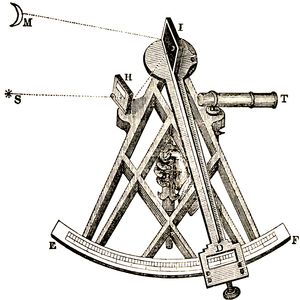 Fig. 9.
Suppose it were required to measure the angular distance between the moon and a certain star,—the moon being at M, and the star at S. The instrument is held firmly in the hand, so that the eye, looking through the telescope, sees the star, S, through the transparent part of the horizon glass. Then the movable arm, ID, is moved from F towards E, until the image of M is reflected down to S, when the number of degrees and parts of a degree reckoned on the limb, from F to the index at D, will show the angular distance between the two bodies.
LETTER VI.
TIME AND THE CALENDAR.
"From old Eternity's mysterious orbWas Time cut off, and cast beneath the skies."—Young.
Having hitherto been conversant only with the many fine and sentimental things which the poets have sung respecting Old Time, perhaps you will find some difficulty in bringing down your mind to the calmer consideration of what time really is, and according to what different standards it is measured for different purposes. You will not, however, I think, find the subject even in our matter-of-fact and unpoetical way of treating it, altogether uninteresting. What, then, is time? Time is a measured portion of indefinite duration. It consists of equal portions cut off from eternity, as a line on the surface of the earth is separated from its contiguous portions that constitute a great circle of the sphere, by applying to it a two-foot scale; or as a few yards of cloth are measured off from a piece of unknown or indefinite extent.
Any thing, or any event which takes place at equal intervals, may become a measure of time. Thus, the pulsations of the wrist, the flowing of a given quantity of sand from one vessel to another, as in the hourglass, the beating of a pendulum, and the revolution of a star, have been severally employed as measures of time. But the great standard of time is the period of the revolution of the earth on its axis, which, by the most exact observations, is found to be always the same. I have anticipated a little of this subject, in giving an account of the transit instrument and clock, but I propose, in this letter, to enter into it more at large.
The time of the earth's revolution on its axis, as already explained, is called a sidereal day, and is determined by the revolution of a star in the heavens. This[60] interval is divided into twenty-four sidereal hours. Observations taken on numerous stars, in different ages of the world, show that they all perform their diurnal revolution in the same time, and that their motion, during any part of the revolution, is always uniform. Here, then, we have an exact measure of time, probably more exact than any thing which can be devised by art. Solar time is reckoned by the apparent revolution of the sun from the meridian round to the meridian again. Were the sun stationary in the heavens, like a fixed star, the time of its apparent revolution would be equal to the revolution of the earth on its axis, and the solar and the sidereal days would be equal. But, since the sun passes from west to east, through three hundred and sixty degrees, in three hundred and sixty-five and one fourth days, it moves eastward nearly one degree a day. While, therefore, the earth is turning round on its axis, the sun is moving in the same direction, so that, when we have come round under the same celestial meridian from which we started, we do not find the sun there, but he has moved eastward nearly a degree, and the earth must perform so much more than one complete revolution, before we come under the sun again. Now, since we move, in the diurnal revolution, fifteen degrees in sixty minutes, we must pass over one degree in four minutes. It takes, therefore, four minutes for us to catch up with the sun, after we have made one complete revolution. Hence the solar day is about four minutes longer than the sidereal; and if we were to reckon the sidereal day twenty-four hours, we should reckon the solar day twenty-four hours four minutes. To suit the purposes of society at large, however, it is found more convenient to reckon the solar days twenty-four hours, and throw the fraction into the sidereal day. Then,
24h. 4m. : 24h. :: 24h. : 23h. 56m. 4s.
That is, when we reduce twenty-four hours and four minutes to twenty-four hours, the same proportion will require that we reduce the sidereal day from twenty-four hours to twenty-three hours fifty-six minutes four sec[61]onds; or, in other words, a sidereal day is such a part of a solar day. The solar days, however, do not always differ from the sidereal by precisely the same fraction, since they are not constantly of the same length. Time, as measured by the sun, is called apparent time, and a clock so regulated as always to keep exactly with the sun, is said to keep apparent time. Mean time is time reckoned by the average length of all the solar days throughout the year. This is the period which constitutes the civil day of twenty-four hours, beginning when the sun is on the lower meridian, namely, at twelve o'clock at night, and counted by twelve hours from the lower to the upper meridian, and from the upper to the lower. The astronomical day is the apparent solar day counted through the whole twenty-four hours, (instead of by periods of twelve hours each, as in the civil day,) and begins at noon. Thus it is now the tenth of June, at nine o'clock, A.M., according to civil time; but we have not yet reached the tenth of June by astronomical time, nor shall we, until noon to-day; consequently, it is now June ninth, twenty-first hour of astronomical time. Astronomers, since so many of their observations are taken on the meridian, are always supposed to look towards the south. Geographers, having formerly been conversant only with the northern hemisphere, are always understood to be looking towards the north. Hence, left and right, when applied to the astronomer, mean east and west, respectively; but to the geographer the right is east, and the left, west.
Clocks are usually regulated so as to indicate mean solar time; yet, as this is an artificial period not marked off, like the sidereal day, by any natural event, it is necessary to know how much is to be added to, or subtracted from, the apparent solar time, in order to give the corresponding mean time. The interval, by which apparent time differs from mean time, is called the equation of time. If one clock is so constructed as to keep exactly with the sun, going faster or slower, according as the lengths of the solar days vary, and another clock[62] is regulated to mean time, then the difference of the two clocks, at any period, would be the equation of time for that moment. If the apparent clock were faster than the mean, then the equation of time must be subtracted; but if the apparent clock were slower than the mean, then the equation of time must be added, to give the mean time. The two clocks would differ most about the third of November, when the apparent time is sixteen and one fourth minutes greater than the mean. But since apparent time is sometimes greater and sometimes less than mean time, the two must obviously be sometimes equal to each other. This is, in fact, the case four times a year, namely, April fifteenth, June fifteenth, September first, and December twenty-fourth.
Astronomical clocks are made of the best workmanship, with every advantage that can promote their regularity. Although they are brought to an astonishing degree of accuracy, yet they are not as regular in their movements as the stars are, and their accuracy requires to be frequently tested. The transit instrument itself, when once accurately placed in the meridian, affords the means of testing the correctness of the clock, since one revolution of a star, from the meridian to the meridian again, ought to correspond exactly to twenty-four hours by the clock, and to continue the same, from day to day; and the right ascensions of various stars, as they cross the meridian, ought to be such by the clock, as they are given in the tables, where they are stated according to the accurate determinations of astronomers. Or, by taking the difference of any two stars, on successive days, it will be seen whether the going of the clock is uniform for that part of the day; and by taking the right ascensions of different pairs of stars, we may learn the rate of the clock at various parts of the day. We thus learn, not only whether the clock accurately measures the length of the sidereal day, but also whether it goes uniformly from hour to hour.
Although astronomical clocks have been brought to a great degree of perfection, so as hardly to vary a sec[63]ond for many months, yet none are absolutely perfect, and most are so far from it, as to require to be corrected by means of the transit instrument, every few days. Indeed, for the nicest observations, it is usual not to attempt to bring the clock to a state of absolute correctness, but, after bringing it as near to such a state as can conveniently be done, to ascertain how much it gains or loses in a day; that is, to ascertain the rate of its going, and to make allowance accordingly.
Having considered the manner in which the smaller divisions of time are measured, let us now take a hasty glance at the larger periods which compose the calendar.
As a day is the period of the revolution of the earth on its axis, so a year is the period of the revolution of the earth around the sun. This time, which constitutes the astronomical year, has been ascertained with great exactness, and found to be three hundred and sixty-five days five hours forty-eight minutes and fifty-one seconds. The most ancient nations determined the number of days in the year by means of the stylus, a perpendicular rod which casts its shadow on a smooth plane bearing a meridian line. The time when the shadow was shortest, would indicate the day of the Summer solstice; and the number of days which elapsed, until the shadow returned to the same length again, would show the number of days in the year. This was found to be three hundred and sixty-five whole days, and accordingly, this period was adopted for the civil year. Such a difference, however, between the civil and astronomical years, at length threw all dates into confusion. For if, at first, the Summer solstice happened on the twenty-first of June, at the end of four years, the sun would not have reached the solstice until the twenty-second of June; that is, it would have been behind its time. At the end of the next four years, the solstice would fall on the twenty-third; and in process of time, it would fall successively on every day of the year. The same would be true of any other fixed date.[64]
Julius Cæsar, who was distinguished alike for the variety and extent of his knowledge, and his skill in arms, first attempted to make the calendar conform to the motions of the sun.
"Amidst the hurry of tumultuous war,The stars, the gods, the heavens, were still his care."
Aided by Sosigenes, an Egyptian astronomer, he made the first correction of the calendar, by introducing an additional day every fourth year, making February to consist of twenty-nine instead of twenty-eight days, and of course the whole year to consist of three hundred and sixty-six days. This fourth year was denominated Bissextile, because the sixth day before the Kalends of March was reckoned twice. It is also called Leap Year.
The Julian year was introduced into all the civilized nations that submitted to the Roman power, and continued in general use until the year 1582. But the true correction was not six hours, but five hours forty-nine minutes; hence the addition was too great by eleven minutes. This small fraction would amount in one hundred years to three fourths of a day, and in one thousand years to more than seven days. From the year 325 to the year 1582, it had, in fact, amounted to more than ten days; for it was known that, in 325, the vernal equinox fell on the twenty-first of March, whereas, in 1582, it fell on the eleventh. It was ordered by the Council of Nice, a celebrated ecclesiastical council, held in the year 325, that Easter should be celebrated upon the first Sunday after the first full moon, next following the vernal equinox; and as certain other festivals of the Romish Church were appointed at particular seasons of the year, confusion would result from such a want of constancy between any fixed date and a particular season of the year. Suppose, for example, a festival accompanied by numerous religious ceremonies, was decreed by the Church to be held at the time when the sun crossed the equator in the Spring, (an event hailed with great joy, as the harbinger of the return of Summer,) and that, in the year 325, March[65] twenty-first was designated as the time for holding the festival, since, at that period, it was on the twenty-first of March when the sun reached the equinox; the next year, the sun would reach the equinox a little sooner than the twenty-first of March, only eleven minutes, indeed, but still amounting in twelve hundred years to ten days; that is, in 1582, the sun reached the equinox on the eleventh of March. If, therefore, they should continue to observe the twenty-first as a religious festival in honor of this event, they would commit the absurdity of celebrating it ten days after it had passed by. Pope Gregory the Thirteenth, who was then at the head of the Roman See, was a man of science, and undertook to reform the calendar, so that fixed dates would always correspond to the same seasons of the year. He first decreed, that the year should be brought forward ten days, by reckoning the fifth of October the fifteenth; and, in order to prevent the calendar from falling into confusion afterwards, he prescribed the following rule: Every year whose number is not divisible by four, without a remainder, consists of three hundred and sixty-five days; every year which is so divisible, but is not divisible by one hundred, of three hundred and sixty-six; every year divisible by one hundred, but not by four hundred, again, of three hundred and sixty-five; and every year divisible by four hundred, of three hundred and sixty-six.
Thus the year 1838, not being divisible by four, contains three hundred and sixty-five days, while 1836 and 1840 are leap years. Yet, to make every fourth year consist of three hundred and sixty-six days would increase it too much, by about three fourths of a day in a century; therefore every hundredth year has only three hundred and sixty-five days. Thus 1800, although divisible by four, was not a leap year, but a common year. But we have allowed a whole day in a hundred years, whereas we ought to have allowed only three fourths of a day. Hence, in four hundred years, we should allow a day too much, and therefore, we let the[66] four hundredth remain a leap year. This rule involves an error of less than a day in four thousand two hundred and thirty-seven years.
The Pope, who, you will recollect, at that age assumed authority over all secular princes, issued his decree to the reigning sovereigns of Christendom, commanding the observance of the calendar as reformed by him. The decree met with great opposition among the Protestant States, as they recognised in it a new exercise of ecclesiastical tyranny; and some of them, when they received it, made it expressly understood, that their acquiescence should not be construed as a submission to the Papal authority.
In 1752, the Gregorian year, or New Style, was established in Great Britain by act of Parliament; and the dates of all deeds, and other legal papers, were to be made according to it. As above a century had then passed since the first introduction of the new style, eleven days were suppressed, the third of September being called the fourteenth. By the same act, the beginning of the year was changed from March twenty-fifth to January first. A few persons born previously to 1752 have come down to our day, and we frequently see inscriptions on tombstones of those whose time of birth is recorded in old style. In order to make this correspond to our present mode of reckoning, we must add eleven days to the date. Thus the same event would be June twelfth of old style, or June twenty-third of new style; and if an event occurred between January first and March twenty-fifth, the date of the year would be advanced one, since February 1st, 1740, O.S. would be February 1st, 1741, N.S. Thus, General Washington was born February 11th, 1731, O.S., or February 22d, 1732, N.S. If we inquire how any present event may be made to correspond in date to the old style, we must subtract twelve days, and put the year back one, if the event lies between January first and March twenty-fifth. Thus, June tenth, N.S. corresponds to May twenty-ninth, O.S.; and March 20th, 1840, to[67] March 8th, 1839. France, being a Roman Catholic country, adopted the new style soon after it was decreed by the Pope; but Protestant countries, as we have seen, were much slower in adopting it; and Russia, and the Greek Church generally, still adhere to the old style. In order, therefore, to make the Russian dates correspond to ours, we must add to them twelve days.
It may seem to you very remarkable, that so much pains should have been bestowed upon this subject; but without a correct and uniform standard of time, the dates of deeds, commissions, and all legal papers; of fasts and festivals, appointed by ecclesiastical authority; the returns of seasons, and the records of history,—must all fall into inextricable confusion. To change the observance of certain religious feasts, which have been long fixed to particular days, is looked upon as an impious innovation; and though the times of the events, upon which these ceremonies depend, are utterly unknown, it is still insisted upon by certain classes in England, that the Glastenbury thorn blooms on Christmas day.
Although the ancient Grecian calendar was extremely defective, yet the common people were entirely averse to its reformation. Their superstitious adherence to these errors was satirized by Aristophanes, in his comedy of the Clouds. An actor, who had just come from Athens, recounts that he met with Diana, or the moon, and found her extremely incensed, that they did not regulate her course better. She complained, that the order of Nature was changed, and every thing turned topsyturvy. The gods no longer knew what belonged to them; but, after paying their visits on certain feast-days, and expecting to meet with good cheer, as usual, they were under the disagreeable necessity of returning back to heaven without their suppers.
Among the Greeks, and other ancient nations, the length of the year was generally regulated by the course of the moon. This planet, on account of the different appearances which she exhibits at her full, change, and[68] quarters, was considered by them as best adapted of any of the celestial bodies for this purpose. As one lunation, or revolution of the moon around the earth, was found to be completed in about twenty-nine and one half days, and twelve of these periods being supposed equal to one revolution of the sun, their months were made to consist of twenty-nine and thirty days alternately, and their year of three hundred and fifty-four days. But this disagreed with the annual revolution of the sun, which must evidently govern the seasons of the year, more than eleven days. The irregularities, which such a mode of reckoning would occasion, must have been too obvious not to have been observed. For, supposing it to have been settled, at any particular time, that the beginning of the year should be in the Spring; in about sixteen years afterwards, the beginning would have been in Autumn; and in thirty-three or thirty-four years, it would have gone backwards through all the seasons, to Spring again. This defect they attempted to rectify, by introducing a number of days, at certain times, into the calendar, as occasion required, and putting the beginning of the year forwards, in order to make it agree with the course of the sun. But as these additions, or intercalations, as they were called, were generally consigned to the care of the priests, who, from motives of interest or superstition, frequently omitted them, the year was made long or short at pleasure.
The week is another division of time, of the highest antiquity, which, in almost all countries, has been made to consist of seven days; a period supposed by some to have been traditionally derived from the creation of the world; while others imagine it to have been regulated by the phases of the moon. The names, Saturday, Sunday, and Monday, are obviously derived from Saturn, the Sun, and the Moon; while Tuesday, Wednesday, Thursday, and Friday, are the days of Tuisco, Woden, Thor, and Friga, which are Saxon names for Mars, Mercury, Jupiter, and Venus.[4][69]
The common year begins and ends on the same day of the week; but leap year ends one day later than it began. Fifty-two weeks contain three hundred and sixty-four days; if, therefore, the year begins on Tuesday, for example, we should complete fifty-two weeks on Monday, leaving one day, (Tuesday,) to complete the year, and the following year would begin on Wednesday. Hence, any day of the month is one day later in the week, than the corresponding day of the preceding year. Thus, if the sixteenth of November, 1838, falls on Friday, the sixteenth of November, 1837, fell on Thursday, and will fall, in 1839, on Saturday. But if leap year begins on Sunday, it ends on Monday, and the following year begins on Tuesday; while any given day of the month is two days later in the week than the corresponding date of the preceding year.
LETTER VII.
FIGURE OF THE EARTH.
"He took the golden compasses, preparedIn God's eternal store, to circumscribeThis universe, and all created things;One foot he centred, and the other turnedRound through the vast profundity obscure,
In the earliest ages, the earth was regarded as one continued plane; but, at a comparatively remote period, as five hundred years before the Christian era, astronomers began to entertain the opinion that the earth is round. We are able now to adduce various arguments which severally prove this truth. First, when a ship is coming in from sea, we first observe only the very highest parts of the ship, while the lower portions come successively into view. Were the earth a continued plane, the lower parts of the ship would be visible as soon as the higher, as is evident from Fig. 10, page 70.[70]
 Fig. 10.
Since light comes to the eye in straight lines, by which objects become visible, it is evident, that no reason exists why the parts of the ship near the water should not be seen as soon as the upper parts. But if the earth be a sphere, then the line of sight would pass above the deck of the ship, as is represented in Fig. 11; and as the ship drew nearer to land, the lower parts would successively rise above this line and come into view exactly in the manner known to observation. Secondly,[71] in a lunar eclipse, which is occasioned by the moon's passing through the earth's shadow, the figure of the shadow is seen to be spherical, which could not be the case unless the earth itself were round. Thirdly, navigators, by steering continually in one direction, as east or west, have in fact come round to the point from which they started, and thus confirmed the fact of the earth's rotundity beyond all question. One may also reach a given place on the earth, by taking directly opposite courses. Thus, he may reach Canton in China, by a westerly route around Cape Horn, or by an easterly route around the Cape of Good Hope. All these arguments severally prove that the earth is round.
 Fig. 11.
But I propose, in this Letter, to give you some account of the unwearied labors which have been performed to ascertain the exact figure of the earth; for although the earth is properly described in general language as round, yet it is not an exact sphere. Were it so, all its diameters would be equal; but it is known that a diameter drawn through the equator exceeds one drawn from pole to pole, giving to the earth the form of a spheroid,—a figure resembling an orange, where the ends are flattened a little and the central parts are swelled out.
Although it would be a matter of very rational curiosity, to investigate the precise shape of the planet on which Heaven has fixed our abode, yet the immense pains which has been bestowed on this subject has not all arisen from mere curiosity. No accurate measurements can be taken of the distances and magnitudes of the heavenly bodies, nor any exact determinations made of their motions, without a knowledge of the exact figure of the earth; and hence is derived a powerful motive for ascertaining this element with all possible precision.
The first satisfactory evidence that was obtained of the exact figure of the earth was derived from reasoning on the effects of the earth's centrifugal force, occasioned by its rapid revolution on its own axis. When water is whirled in a pail, we see it recede from the[72] centre and accumulate upon the sides of the vessel; and when a millstone is whirled rapidly, since the portions of the stone furthest from the centre revolve much more rapidly than those near to it, their greater tendency to recede sometimes makes them fly off with a violent explosion. A case, which comes still nearer to that of the earth, is exhibited by a mass of clay revolving on a potter's wheel, as seen in the process of making earthen vessels. The mass swells out in the middle, in consequence of the centrifugal force exerted upon it by a rapid motion. Now, in the diurnal revolution, the equatorial parts of the earth move at the rate of about one thousand miles per hour, while the poles do not move at all; and since, as we take points at successive distances from the equator towards the pole, the rate at which these points move grows constantly less and less; and since, in revolving bodies, the centrifugal force is proportioned to the velocity, consequently, those parts which move with the greatest rapidity will be more affected by this force than those which move more slowly. Hence, the equatorial regions must be higher from the centre than the polar regions; for, were not this the case, the waters on the surface of the earth would be thrown towards the equator, and be piled up there, just as water is accumulated on the sides of a pail when made to revolve rapidly.
Huyghens, an eminent astronomer of Holland, who investigated the laws of centrifugal forces, was the first to infer that such must be the actual shape of the earth; but to Sir Isaac Newton we owe the full developement of this doctrine. By combining the reasoning derived from the known laws of the centrifugal force with arguments derived from the principles of universal gravitation, he concluded that the distance through the earth, in the direction of the equator, is greater than that in the direction of the poles. He estimated the difference to be about thirty-four miles.
But it was soon afterwards determined by the astronomers of France, to ascertain the figure of the earth by[73] actual measurements, specially instituted for that purpose. Let us see how this could be effected. If we set out at the equator and travel towards the pole, it is easy to see when we have advanced one degree of latitude, for this will be indicated by the rising of the north star, which appears in the horizon when the spectator stands on the equator, but rises in the same proportion as he recedes from the equator, until, on reaching the pole, the north star would be seen directly over head. Now, were the earth a perfect sphere, the meridian of the earth would be a perfect circle, and the distance between any two places, differing one degree in latitude, would be exactly equal to the distance between any other two places, differing in latitude to the same amount. But if the earth be a spheroid, flattened at the poles, then a line encompassing the earth from north to south, constituting the terrestrial meridian, would not be a perfect circle, but an ellipse or oval, having its longer diameter through the equator, and its shorter through the poles. The part of this curve included between two radii, drawn from the centre of the earth to the celestial meridian, at angles one degree asunder, would be greater in the polar than in the equatorial region; that is, the degrees of the meridian would lengthen towards the poles.
The French astronomers, therefore, undertook to ascertain by actual measurements of arcs of the meridian, in different latitudes, whether the degrees of the meridian are of uniform length, or, if not, in what manner they differ from each other. After several indecisive measurements of an arc of the meridian in France, it was determined to effect simultaneous measurements of arcs of the meridian near the equator, and as near as possible to the north pole, presuming that if degrees of the meridian, in different latitudes, are really of different lengths, they will differ most in points most distant from each other. Accordingly, in 1735, the French Academy, aided by the government, sent out two expeditions, one to Peru and the other to Lapland. Three distin[74]guished mathematicians, Bouguer, La Condamine, and Godin, were despatched to the former place, and four others, Maupertius, Camus, Clairault, and Lemonier, were sent to the part of Swedish Lapland which lies at the head of the Gulf of Tornea, the northern arm of the Baltic. This commission completed its operations several years sooner than the other, which met with greater difficulties in the way of their enterprise. Still, the northern detachment had great obstacles to contend with, arising particularly from the extreme length and severity of their Winters. The measurements, however, were conducted with care and skill, and the result, when compared with that obtained for the length of a degree in France, plainly indicated, by its greater amount, a compression of the earth towards the poles.
Mean-while, Bouguer and his party were prosecuting a similar work in Peru, under extraordinary difficulties. These were caused, partly by the localities, and partly by the ill-will and indolence of the inhabitants. The place selected for their operations was in an elevated valley between two principal chains of the Andes. The lowest point of their arc was at an elevation of a mile and a half above the level of the sea; and, in some instances, the heights of two neighboring signals differed more than a mile. Encamped upon lofty mountains, they had to struggle against storms, cold, and privations of every description, while the invincible indifference of the Indians, they were forced to employ, was not to be shaken by the fear of punishment or the hope of reward. Yet, by patience and ingenuity, they overcame all obstacles, and executed with great accuracy one of the most important operations, of this nature, ever undertaken. To accomplish this, however, took them nine years; of which, three were occupied in determining the latitudes alone.[5]
I have recited the foregoing facts, in order to give you some idea of the unwearied pains which astronomers have taken to ascertain the exact figure of the earth.[75] You will find, indeed, that all their labors are characterized by the same love of accuracy. Years of toilsome watchings, and incredible labor of computation, have been undergone, for the sake of arriving only a few seconds nearer to the truth.
The length of a degree of the meridian, as measured in Peru, was less than that before determined in France, and of course less than that of Lapland; so that the spheroidal figure of the earth appeared now to be ascertained by actual measurement. Still, these measures were too few in number, and covered too small a portion of the whole quadrant from the equator to the pole, to enable astronomers to ascertain the exact law of curvature of the meridian, and therefore similar measurements have since been prosecuted with great zeal by different nations, particularly by the French and English. In 1764, two English mathematicians of great eminence, Mason and Dixon, undertook the measurement of an arc in Pennsylvania, extending more than one hundred miles.
 Fig. 12.
These operations are carried on by what is called a system of triangulation. Without some knowledge of trigonometry, you will not be able fully to understand this process; but, as it is in its nature somewhat curious, and is applied to various other geographical measurements, as well as to the determination of arcs of the meridian, I am desirous that you should understand its general principles. Let us reflect, then, that it must be a matter of the greatest difficulty, to execute with exactness the measurement of a line of any great length in one continued direction on the earth's surface. Even if we select a level and open country, more or less inequalities of surface will occur; rivers must be crossed, morasses must be traversed, thickets must be penetrated, and innumerable other obstacles must be surmounted; and finally, every time we apply an artificial measure, as a rod, for example, we obtain a result not absolutely perfect. Each error may indeed be very small, but small errors, often repeated, may produce a[76] formidable aggregate. Now, one unacquainted with trigonometry can easily understand the fact, that, when we know certain parts of a triangle, we can find the other parts by calculation; as, in the rule of three in arithmetic, we can obtain the fourth term of a proportion, from having the first three terms given. Thus, in the triangle A B C, Fig. 12, if we know the side A B, and the angles at A and B, we can find by computation, the other sides, A C and B C, and the remaining angle at C. Suppose, then, that in measuring an arc of the meridian through any country, the line were to pass directly through A B, but the ground was so obstructed between A and B, that we could not possibly carry our measurement through it. We might then measure another line, as A C, which was accessible, and with a compass take the bearing of B from the points A and C, by which means we should learn the value of the angles at A and C. From these data we might calculate, by the rules of trigonometry, the exact length of the line A B. Perhaps the ground might be so situated, that we could not reach the point B, by any route; still, if it could be seen from A and C, it would be all we should want. Thus, in conducting a trigonometrical survey of any country, conspicuous signals are placed on elevated points, and the bearings of these are taken from the extremities of a known line, called the base, and thus the relative situation of various places is accurately determined. Were we to undertake to run an exact north and south line through any country, as New England, we should select, near one extremity, a spot of ground favorable for actual measurement, as a level, unobstructed plain; we should provide a measure whose length in feet and inches was determined with the greatest possible precision, and should apply it with the utmost care. We should thus obtain a base line. From the extremities of this line, we should take (with some appropriate instrument) the[77] bearing of some signal at a greater or less distance, and thus we should obtain one side and two angles of a triangle, from which we could find, by the rules of trigonometry, either of the unknown sides. Taking this as a new base, we might take the bearing of another signal, still further on our way, and thus proceed to run the required north and south line, without actually measuring any thing more than the first, or base line.
 Fig. 13.
Thus, in Fig. 13, we wish to measure the distance between the two points A and O, which are both on the same meridian, as is known by their having the same longitude; but, on account of various obstacles, it would be found very inconvenient to measure this line directly, with a rod or chain, and even if we could do it, we could not by this method obtain nearly so accurate a result, as we could by a series of triangles, where, after the base line was measured, we should have nothing else to measure except angles, which can be determined, by observation, to a greater degree of exactness, than lines. We therefore, in the first place, measure the base line, A B, with the utmost precision. Then, taking the bearing of some signal at C from A and B, we obtain the means of calculating the side B C, as has been already explained. Taking B C as a new base, we proceed, in like manner, to determine successively the sides C D, D E, and E F, and also A C, and C E. Although A C is not in the direction of the meridian, but considerably to the east of it, yet it is easy to find the corresponding distance on the meridian, A M; and in the same manner we can find the portions of the meridian M N and N O, corresponding respectively to C E and[78] E F. Adding these several parts of the meridian together, we obtain the length of the arc from A to O, in miles; and by observations on the north star, at each extremity of the arc, namely, at A and at O, we could determine the difference of latitude between these two points. Suppose, for example, that the distance between A and O is exactly five degrees, and that the length of the intervening line is three hundred and forty-seven miles; then, dividing the latter by the former number, we find the length of a degree to be sixty-nine miles and four tenths. To take, however, a few of the results actually obtained, they are as follows:
| Places of observation. |
Latitude. |
Length of a deg. in miles. |
| Peru, |
00° 00' 00" |
68.732 |
| Pennsylvania, |
39 12 00 |
68.896 |
| France, |
46 12 00 |
69.054 |
| England, |
51 29 54½ |
69.146 |
| Sweden, |
66 20 10 |
69.292 |
This comparison shows, that the length of a degree gradually increases, as we proceed from the equator towards the pole. Combining the results of various estimates, the dimensions of the terrestrial spheroid are found to be as follows:
| Equatorial diameter, |
7925.648 miles. |
| Polar diameter, |
7899.170 " |
| Average diameter, |
7912.409 " |
The difference between the greatest and the least is about twenty-six and one half miles, which is about one two hundred and ninety-ninth part of the greatest. This fraction is denominated the ellipticity of the earth,—being the excess of the equatorial over the polar diameter.
The operations, undertaken for the purpose of determining the figure of the earth, have been conducted with the most refined exactness. At any stage of the process, the length of the last side, as obtained by calculation, may be actually measured in the same manner[79] as the base from which the series of triangles commenced. When thus measured, it is called the base of verification. In some surveys, the base of verification, when taken at a distance of four hundred miles from the starting point, has not differed more than one foot from the same line, as determined by calculation.
Another method of arriving at the exact figure of the earth is, by observations with the pendulum. If a pendulum, like that of a clock, be suspended, and the number of its vibrations per hour be counted, they will be found to be different in different latitudes. A pendulum that vibrates thirty-six hundred times per hour, at the equator, will vibrate thirty-six hundred and five and two thirds times, at London, and a still greater number of times nearer the north pole. Now, the vibrations of the pendulum are produced by the force of gravity. Hence their comparative number at different places is a measure of the relative forces of gravity at those places. But when we know the relative forces of gravity at different places, we know their relative distances from the centre of the earth; because the nearer a place is to the centre of the earth, the greater is the force of gravity. Suppose, for example, we should count the number of vibrations of a pendulum at the equator, and then carry it to the north pole, and count the number of vibrations made there in the same time,—we should be able, from these two observations, to estimate the relative forces of gravity at these two points; and, having the relative forces of gravity, we can thence deduce their relative distances from the centre of the earth, and thus obtain the polar and equatorial diameters. Observations of this kind have been taken with the greatest accuracy, in many places on the surface of the earth, at various distances from each other, and they lead to the same conclusions respecting the figure of the earth, as those derived from measuring arcs of the meridian. It is pleasing thus to see a great truth, and one apparently beyond the pale of human investigation, reached by two routes entirely independent of each other. Nor, in[80]deed, are these the only proofs which have been discovered of the spheroidal figure of the earth. In consequence of the accumulation of matter above the equatorial regions of the earth, a body weighs less there than towards the poles, being further removed from the centre of the earth. The same accumulation of matter, by the force of attraction which it exerts, causes slight inequalities in the motions of the moon; and since the amount of these becomes a measure of the force which produces them, astronomers are able, from these inequalities, to calculate the exact quantity of the matter thus accumulated, and hence to determine the figure of the earth. The result is not essentially different from that obtained by the other methods. Finally, the shape of the earth's shadow is altered, by its spheroidal figure,—a circumstance which affects the time and duration of a lunar eclipse. All these different and independent phenomena afford a pleasing example of the harmony of truth. The known effects of the centrifugal force upon a body revolving on its axis, like the earth, lead us to infer that the earth is of a spheroidal figure; but if this be the fact, the pendulum ought to vibrate faster near the pole than at the equator, because it would there be nearer the centre of the earth. On trial, such is found to be the case. If, again, there be such an accumulation of matter about the equatorial regions, its effects ought to be visible in the motions of the moon, which it would influence by its gravity; and there, also, its effects are traced. At length, we apply our measures to the surface of the earth itself, and find the same fact, which had thus been searched out among the hidden things of Nature, here palpably exhibited before our eyes. Finally, on estimating from these different sources, what the exact amount of the compression at the poles must be, all bring out nearly one and the same result. This truth, so harmonious in itself, takes along with it, and establishes, a thousand other truths on which it rests.
LETTER VIII.
DIURNAL REVOLUTIONS.
"To some she taught the fabric of the sphere,The changeful moon, the circuit of the stars,The golden zones of heaven."—Akenside.
With the elementary knowledge already acquired, you will now be able to enter with pleasure and profit on the various interesting phenomena dependent on the revolution of the earth on its axis and around the sun. The apparent diurnal revolution of the heavenly bodies, from east to west, is owing to the actual revolution of the earth on its own axis, from west to east. If we conceive of a radius of the earth's equator extended until it meets the concave sphere of the heavens, then, as the earth revolves, the extremity of this line would trace out a curve on the face of the sky; namely, the celestial equator. In curves parallel to this, called the circles of diurnal revolution, the heavenly bodies actually appear to move, every star having its own peculiar circle. After you have first rendered familiar the real motion of the earth from west to east, you may then, without danger of misapprehension, adopt the common language, that all the heavenly bodies revolve around the earth once a day, from east to west, in circles parallel to the equator and to each other.
I must remind you, that the time occupied by a star, in passing from any point in the meridian until it comes round to the same point again, is called a sidereal day, and measures the period of the earth's revolution on its axis. If we watch the returns of the same star from day to day, we shall find the intervals exactly equal to each other; that is, the sidereal days are all equal. Whatever star we select for the observation, the same result will be obtained. The stars, therefore, always keep the same relative position, and have a common[82] movement round the earth,—a consequence that naturally flows from the hypothesis that their apparent motion is all produced by a single real motion; namely, that of the earth. The sun, moon, and planets, as well as the fixed stars, revolve in like manner; but their returns to the meridian are not, like those of the fixed stars, at exactly equal intervals.
The appearances of the diurnal motions of the heavenly bodies are different in different parts of the earth,—since every place has its own horizon, and different horizons are variously inclined to each other. Nothing in astronomy is more apt to mislead us, than the obstinate habit of considering the horizon as a fixed and immutable plane, and of referring every thing to it. We should contemplate the earth as a huge globe, occupying a small portion of space, and encircled on all sides, at an immense distance, by the starry sphere. We should free our minds from their habitual proneness to consider one part of space as naturally up and another down, and view ourselves as subject to a force (gravity) which binds us to the earth as truly as though we were fastened to it by some invisible cords or wires, as the needle attaches itself to all sides of a spherical loadstone. We should dwell on this point, until it appears to us as truly up, in the direction B B, C C, D D, when one is at B, C, D, respectively, as in the direction A A, when he is at A, Fig. 14.
Let us now suppose the spectator viewing the diurnal revolutions from several different positions on the earth. On the equator, his horizon would pass through both poles; for the horizon cuts the celestial vault at ninety degrees in every direction from the zenith of the spectator; but the pole is likewise ninety degrees from his zenith, when he stands on the equator; and consequently, the pole must be in the horizon. Here, also, the celestial equator would coincide with the prime vertical, being a great circle passing through the east and west points. Since all the diurnal circles are parallel to the equator, consequently, they would all, like the equator[83] be perpendicular to the horizon. Such a view of the heavenly bodies is called a right sphere, which may be thus defined: a right sphere is one in which all the daily revolutions of the stars are in circles perpendicular to the horizon.
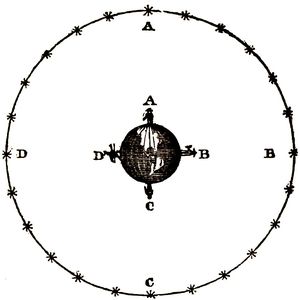 Fig. 14.
A right sphere is seen only at the equator. Any star situated in the celestial equator would appear to rise directly in the east, at midnight to be in the zenith of the spectator, and to set directly in the west. In proportion as stars are at a greater distance from the equator towards the pole, they describe smaller and smaller circles, until, near the pole, their motion is hardly perceptible.
If the spectator advances one degree from the equator towards the north pole, his horizon reaches one degree beyond the pole of the earth, and cuts the starry sphere one degree below the pole of the heavens, or below the north star, if that be taken as the place of the pole. As he moves onward towards the pole, his horizon continually reaches further and further beyond it, until, when he comes to the pole of the earth, and under the pole of the heavens, his horizon reaches on all sides to the equator, and coincides with it. More[84]over, since all the circles of daily motion are parallel to the equator, they become, to the spectator at the pole, parallel to the horizon. Or, a parallel sphere is that in which all the circles of daily motion are parallel to the horizon.
To render this view of the heavens familiar, I would advise you to follow round in mind a number of separate stars, in their diurnal revolution, one near the horizon, one a few degrees above it, and a third near the zenith. To one who stood upon the north pole, the stars of the northern hemisphere would all be perpetually in view when not obscured by clouds, or lost in the sun's light, and none of those of the southern hemisphere would ever be seen. The sun would be constantly above the horizon for six months in the year, and the remaining six continually out of sight. That is, at the pole, the days and nights are each six months long. The appearances at the south pole are similar to those at the north.
A perfect parallel sphere can never be seen, except at one of the poles,—a point which has never been actually reached by man; yet the British discovery ships penetrated within a few degrees of the north pole, and of course enjoyed the view of a sphere nearly parallel.
As the circles of daily motion are parallel to the horizon of the pole, and perpendicular to that of the equator, so at all places between the two, the diurnal motions are oblique to the horizon. This aspect of the heavens constitutes an oblique sphere, which is thus defined: an oblique sphere is that in which the circles of daily motion are oblique to the horizon.
Suppose, for example, that the spectator is at the latitude of fifty degrees. His horizon reaches fifty degrees beyond the pole of the earth, and gives the same apparent elevation to the pole of the heavens. It cuts the equator and all the circles of daily motion, at an angle of forty degrees,—being always equal to what the altitude of the pole lacks of ninety degrees: that is, it is always equal to the co-altitude of the pole. Thus,[85] let H O, Fig. 15, represent the horizon, E Q the equator, and P P the axis of the earth. Also, l l, m m, n n, parallels of latitude. Then the horizon of a spectator at Z, in latitude fifty degrees, reaches to fifty degrees beyond the pole; and the angle E C H, which the equator makes with the horizon, is forty degrees,—the complement of the latitude. As we advance still further north, the elevation of the diurnal circle above the horizon grows less and less, and consequently, the motions of the heavenly bodies more and more oblique to the horizon, until finally, at the pole, where the latitude is ninety degrees, the angle of elevation of the equator vanishes, and the horizon and the equator coincide with each other, as before stated.
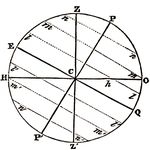 Fig. 15.
The circle of perpetual apparition is the boundary of that space around the elevated pole, where the stars never set. Its distance from the pole is equal to the latitude of the place. For, since the altitude of the pole is equal to the latitude, a star, whose polar distance is just equal to the latitude, will, when at its lowest point, only just reach the horizon; and all the stars nearer the pole than this will evidently not descend so far as the horizon. Thus m m, Fig. 15, is the circle of perpetual apparition, between which and the north pole, the stars never set, and its distance from the pole, O P, is evidently equal to the elevation of the pole, and of course to the latitude.
In the opposite hemisphere, a similar part of the sphere adjacent to the depressed pole never rises. Hence, the circle of perpetual occultation is the boun[86]dary of that space around the depressed pole, within which the stars never rise.
Thus m´ m´, Fig. 15, is the circle of perpetual occultation, between which and the south pole, the stars never rise.
In an oblique sphere, the horizon cuts the circles of daily motion unequally. Towards the elevated pole, more than half the circle is above the horizon, and a greater and greater portion, as the distance from the equator is increased, until finally, within the circle of perpetual apparition, the whole circle is above the horizon. Just the opposite takes place in the hemisphere next the depressed pole. Accordingly, when the sun is in the equator, as the equator and horizon, like all other great circles of the sphere, bisect each other, the days and nights are equal all over the globe. But when the sun is north of the equator, the days become longer than the nights, but shorter, when the sun is south of the equator. Moreover, the higher the latitude, the greater is the inequality in the lengths of the days and nights. By examining Fig. 15, you will easily see how each of these cases must hold good.
Most of the appearances of the diurnal revolution can be explained, either on the supposition that the celestial sphere actually turns around the earth once in twenty-four hours, or that this motion of the heavens is merely apparent, arising from the revolution of the earth on its axis, in the opposite direction,—a motion of which we are insensible, as we sometimes lose the consciousness of our own motion in a ship or steam-boat, and observe all external objects to be receding from us, with a common motion. Proofs, entirely conclusive and satisfactory, establish the fact, that it is the earth, and not the celestial sphere, that turns; but these proofs are drawn from various sources, and one is not prepared to appreciate their value, or even to understand some of them, until he has made considerable proficiency in the study of astronomy, and become familiar with a great variety of astronomical phenomena.[87] To such a period we will therefore postpone the discussion of the earth's rotation on its axis.
While we retain the same place on the earth, the diurnal revolution occasions no change in our horizon, but our horizon goes round, as well as ourselves. Let us first take our station on the equator, at sunrise; our horizon now passes through both the poles and through the sun, which we are to conceive of as at a great distance from the earth, and therefore as cut, not by the terrestrial, but by the celestial, horizon. As the earth turns, the horizon dips more and more below the sun, at the rate of fifteen degrees for every hour; and, as in the case of the polar star, the sun appears to rise at the same rate. In six hours, therefore, it is depressed ninety degrees below the sun, bringing us directly under the sun, which, for our present purpose, we may consider as having all the while maintained the same fixed position in space. The earth continues to turn, and in six hours more, it completely reverses the position of our horizon, so that the western part of the horizon, which at sunrise was diametrically opposite to the sun, now cuts the sun, and soon afterwards it rises above the level of the sun, and the sun sets. During the next twelve hours, the sun continues on the invisible side of the sphere, until the horizon returns to the position from which it set out, and a new day begins.
Let us next contemplate the similar phenomena at the poles. Here the horizon, coinciding, as it does, with the equator, would cut the sun through its centre and the sun would appear to revolve along the surface of the sea, one half above and the other half below the horizon. This supposes the sun in its annual revolution to be at one of the equinoxes. When the sun is north of the equator, it revolves continually round in a circle, which, during a single revolution, appears parallel to the equator, and it is constantly day; and when the sun is south of the equator, it is, for the same reason, continual night.
When we have gained a clear idea of the appear[88]ances of the diurnal revolutions, as exhibited to a spectator at the equator and at the pole, that is, in a right and in a parallel sphere, there will be little difficulty in imagining how they must be in the intermediate latitudes, which have an oblique sphere.
The appearances of the sun and stars, presented to the inhabitants of different countries, are such as correspond to the sphere in which they live. Thus, in the fervid climates of India, Africa, and South America, the sun mounts up to the highest regions of the heavens, and descends directly downwards, suddenly plunging beneath the horizon. His rays, darting almost vertically upon the heads of the inhabitants, strike with a force unknown to the people of the colder climates; while in places remote from the equator, as in the north of Europe, the sun, in Summer, rises very far in the north, takes a long circuit towards the south, and sets as far northward in the west as the point where it rose on the other side of the meridian. As we go still further north, to the northern parts of Norway and Sweden, for example, to the confines of the frigid zone, the Summer's sun just grazes the northern horizon, and at noon appears only twenty-three and one half degrees above the southern. On the other hand, in mid-winter, in the north of Europe, as at St. Petersburgh, the day dwindles almost to nothing,—lasting only while the sun describes a very short arc in the extreme south. In some parts of Siberia and Iceland, the only day consists of a little glimmering of the sun on the verge of
LETTER IX.
PARALLAX AND REFRACTION.
"Go, wondrous creature! mount where science guides,Go measure earth, weigh air, and state the tides;Instruct the planets in what orbs to run,Correct old Time, and regulate the sun."—Pope.
I think you must have felt some astonishment, that astronomers are able to calculate the exact distances and magnitudes of the sun, moon, and planets. We should, at the first thought, imagine that such knowledge as this must be beyond the reach of the human faculties, and we might be inclined to suspect that astronomers practise some deception in this matter, for the purpose of exciting the admiration of the unlearned. I will therefore, in the present Letter, endeavor to give you some clear and correct views respecting the manner in which astronomers acquire this knowledge.
In our childhood, we all probably adopt the notion that the sky is a real dome of definite surface, in which the heavenly bodies are fixed. When any objects are beyond a certain distance from the eye, we lose all power of distinguishing, by our sight alone, between different distances, and cannot tell whether a given object is one million or a thousand millions of miles off. Although the bodies seen in the sky are in fact at distances extremely various,—some, as the clouds, only a few miles off; others, as the moon, but a few thousand miles; and others, as the fixed stars, innumerable millions of miles from us,—yet, as our eye cannot distinguish these different distances, we acquire the habit of referring all objects beyond a moderate height to one and the same surface, namely, an imaginary spherical surface, denominated the celestial vault. Thus, the various objects represented in the diagram on next page, though differing very much in shape and diameter,[90] would all be projected upon the sky alike, and compose a part, indeed, of the imaginary vault itself. The place which each object occupies is determined by lines drawn from the eye of the spectator through the extremities of the body, to meet the imaginary concave sphere. Thus, to a spectator at O, Fig 16, the several lines A B, C D, and E F, would all be projected into arches on the face of the sky, and be seen as parts of the sky itself, as represented by the lines A´ B´, C´ D´, and E´ F´. And were a body actually to move in the several directions indicated by these lines, they would appear to the spectator to describe portions of the celestial vault. Thus, even when moving through the crooked line, from a to b, a body would appear to be moving along the face of the sky, and of course in a regular curve line, from c to d.
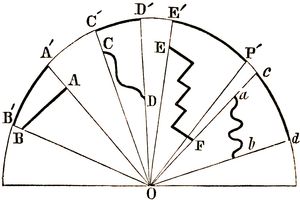 Fig. 16.
But, although all objects, beyond a certain moderate height, are projected on the imaginary surface of the sky, yet different spectators will project the same object on different parts of the sky. Thus, a spectator at A, Fig. 17, would see a body, C, at M, while a spectator at B would see the same body at N. This change of place in a body, as seen from different points, is called parallax, which is thus defined: parallax is the apparent change of place which bodies undergo by being viewed from different points.[91]
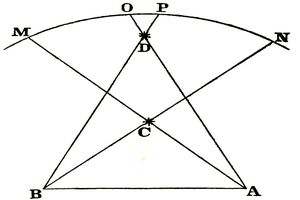 Fig. 17.
The arc M N is called the parallactic arc, and the angle A C B, the parallactic angle.
It is plain, from the figure, that near objects are much more affected by parallax than distant ones. Thus, the body C, Fig. 17, makes a much greater parallax than the more distant body D,—the former being measured by the arc M N, and the latter by the arc O P. We may easily imagine bodies to be so distant, that they would appear projected at very nearly the same point of the heavens, when viewed from places very remote from each other. Indeed, the fixed stars, as we shall see more fully hereafter, are so distant, that spectators, a hundred millions of miles apart, see each star in one and the same place in the heavens.
 Fig. 18.
It is by means of parallax, that astronomers find the distances and magnitudes of the heavenly bodies. In order fully to understand this subject, one requires to know something of trigonometry, which science enables us to find certain unknown parts of a triangle from certain other parts which are known. Although you may not be acquainted with the principles of trigonometry, yet you will readily understand, from your knowledge of arithmetic, that from certain things given in a problem others may be found. Every triangle has of course three sides and three angles; and, if we know[92] two of the angles and one of the sides, we can find all the other parts, namely, the remaining angle and the two unknown sides. Thus, in the triangle A B C, Fig. 18, if we know the length of the side A B, and how many degrees each of the angles A B C and B C A contains, we can find the length of the side B C, or of the side A C, and the remaining angle at A. Now, let us apply these principles to the measurements of some of the heavenly bodies.
 Fig. 19.
In Fig. 19, let A represent the earth, C H the horizon, and H Z a quadrant of a great circle of the heavens, extending from the horizon to the zenith; and let E, F, G, O, be successive positions of the moon, at different elevations, from the horizon to the meridian. Now, a spectator on the surface of the earth, at A, would[93] refer the moon, when at E, to h, on the face of the sky, whereas, if seen from the centre of the earth, it would appear at H. So, when the moon was at F, a spectator at A would see it at p, while, if seen from the centre, it would have appeared at P. The parallactic arcs, H h, P p, R r, grow continually smaller and smaller, as a body is situated higher above the horizon; and when the body is in the zenith, then the parallax vanishes altogether, for at O the moon would be seen at Z, whether viewed from A or C.
Since, then, a heavenly body is liable to be referred to different points on the celestial vault, when seen from different parts of the earth, and thus some confusion be occasioned in the determination of points on the celestial sphere, astronomers have agreed to consider the true place of a celestial object to be that where it would appear, if seen from the centre of the earth; and the doctrine of parallax teaches how to reduce observations made at any place on the surface of the earth, to such as they would be, if made from the centre.
When the moon, or any heavenly body, is seen in the horizon, as at E, the change of place is called the horizontal parallax. Thus, the angle A E C, measures the horizontal parallax of the moon. Were a spectator to view the earth from the centre of the moon, he would see the semidiameter of the earth under this same angle; hence, the horizontal parallax of any body is the angle subtended by the semidiameter of the earth, as seen from the body. Please to remember this fact.
It is evident from the figure, that the effect of parallax upon the place of a celestial body is to depress it. Thus, in consequence of parallax, E is depressed by the arc H h; F, by the arc P p; G, by the arc R r; while O sustains no change. Hence, in all calculations respecting the altitude of the sun, moon, or planets, the amount of parallax is to be added: the stars, as we shall see hereafter, have no sensible parallax.
It is now very easy to see how, when the parallax of a body is known, we may find its distance from the[94] centre of the earth. Thus, in the triangle A C E, Fig. 19, the side A C is known, being the semidiameter of the earth; the angle C A E, being a right angle, is also known; and the parallactic angle, A E C, is found from observation; and it is a well-known principle of trigonometry, that when we have any two angles of a triangle, we may find the remaining angle by subtracting the sum of these two from one hundred and eighty degrees. Consequently, in the triangle A E C, we know all the angles and one side, namely, the side A C; hence, we have the means of finding the side C E, which is the distance from the centre of the earth to the centre of the moon.
 Fig. 20.
When the distance of a heavenly body is known, and we can measure, with instruments, its angular breadth, we can easily determine its magnitude. Thus, if we have the distance of the moon, E S, Fig. 20, and half the breadth of its disk S C, (which is measured by the angle S E C,) we can find the length of the line, S C, in miles. Twice this line is the diameter of the body; and when we know the diameter of a sphere, we can, by well-known rules, find the contents of the surface, and its solidity.
You will perhaps be curious to know, how the moon's horizontal parallax is found; for it must have been previously ascertained, before we could apply this method to finding the distance of the moon from the earth. Suppose that two astronomers take their stations on the same meridian, but one south of the equator, as at the Cape of Good Hope, and another north of the equator, as at Berlin, in Prussia, which two places lie nearly on the same meridian. The observers would severally refer the moon to different points on the face of the sky,—the southern observer carrying it further north, and the northern observer fur[95]ther south, than its true place, as seen from the centre of the earth. This will be plain from the diagram, Fig. 21. If A and B represent the positions of the spectators, M the moon, and C D an arc of the sky, then it is evident, that C D would be the parallactic arc.
 Fig. 21.
These observations furnish materials for calculating, by the aid of trigonometry, the moon's horizontal parallax, and we have before seen how, when we know the parallax of a heavenly body, we can find both its distance from the earth and its magnitude.
Beside the change of place which these heavenly bodies undergo, in consequence of parallax, there is another, of an opposite kind, arising from the effect of the atmosphere, called refraction. Refraction elevates the apparent place of a body, while parallax depresses it. It affects alike the most distant as well as nearer bodies.
In order to understand the nature of refraction, we must consider, that an object always appears in the direction in which the last ray of light comes to the eye. If the light which comes from a star were bent into fifty directions before it reached the eye, the star would nevertheless appear in the line described by the ray nearest the eye. The operation of this principle is seen when an oar, or any stick, is thrust into water. As the rays of light by which the oar is seen have their direction changed as they pass out of water into air, the apparent direction in which the body is seen is changed in the same degree, giving it a bent appearance,—the part below the water having apparently a different direction from the part above. Thus, in Fig. 22, page 96, if S a x be the oar, S a b will be the bent appearance, as affected by refraction. The transparent substance[96] through which any ray of light passes is called a medium. It is a general fact in optics, that, when light passes out of a rarer into a denser medium, as out of air into water, or out of space into air, it is turned towards a perpendicular to the surface of the medium; and when it passes out of a denser into a rarer medium, as out of water into air, it is turned from the perpendicular. In the above case, the light, passing out of space into air, is turned towards the radius of the earth, this being perpendicular to the surface of the atmosphere; and it is turned more and more towards that radius the nearer it approaches to the earth, because the density of the air rapidly increases near the earth.
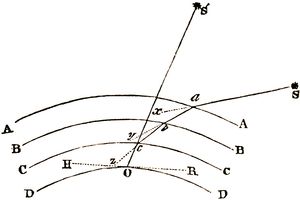 Fig. 22.
Let us now conceive of the atmosphere as made up of a great number of parallel strata, as A A, B B, C C, and D D, increasing rapidly in density (as is known to be the fact) in approaching near to the surface of the earth. Let S be a star, from which a ray of light, S a, enters the atmosphere at a, where, being much turned towards the radius of the convex surface, it would change its direction into the line a b, and again into b c, and c O, reaching the eye at O. Now, since an object always appears in the direction in which the light finally strikes the eye, the star would be seen in the direction O c, and, consequently, the star would[97] apparently change its place, by refraction, from S to S´, being elevated out of its true position. Moreover, since, on account of the continual increase of density in descending through the atmosphere, the light would be continually turned out of its course more and more, it would therefore move, not in the polygon represented in the figure, but in a corresponding curve line, whose curvature is rapidly increased near the surface of the earth.
When a body is in the zenith, since a ray of light from it enters the atmosphere at right angles to the refracting medium, it suffers no refraction. Consequently, the position of the heavenly bodies, when in the zenith, is not changed by refraction, while, near the horizon, where a ray of light strikes the medium very obliquely, and traverses the atmosphere through its densest part, the refraction is greatest. The whole amount of refraction, when a body is in the horizon, is thirty-four minutes; while, at only an elevation of one degree, the refraction is but twenty-four minutes; and at forty-five degrees, it is scarcely a single minute. Hence it is always important to make our observations on the heavenly bodies when they are at as great an elevation as possible above the horizon, being then less affected by refraction than at lower altitudes.
Since the whole amount of refraction near the horizon exceeds thirty-three minutes, and the diameters of the sun and moon are severally less than this, these luminaries are in view both before they have actually risen and after they have set.
The rapid increase of refraction near the horizon is strikingly evinced by the oval figure which the sun assumes when near the horizon, and which is seen to the greatest advantage when light clouds enable us to view the solar disk. Were all parts of the sun equally raised by refraction, there would be no change of figure; but, since the lower side is more refracted than the upper, the effect is to shorten the vertical diameter, and thus to give the disk an oval form. This effect is particularly remarkable when the sun, at his rising or setting, is ob[98]served from the top of a mountain, or at an elevation near the seashore; for in such situations, the rays of light make a greater angle than ordinary with a perpendicular to the refracting medium, and the amount of refraction is proportionally greater. In some cases of this kind, the shortening of the vertical diameter of the sun has been observed to amount to six minutes, or about one fifth of the whole.
The apparent enlargement of the sun and moon, when near the horizon, arises from an optical illusion. These bodies, in fact, are not seen under so great an angle when in the horizon as when on the meridian, for they are nearer to us in the latter case than in the former. The distance of the sun, indeed, is so great, that it makes very little difference in his apparent diameter whether he is viewed in the horizon or on the meridian; but with the moon, the case is otherwise; its angular diameter, when measured with instruments, is perceptibly larger when at its culmination, or highest elevation above the horizon. Why, then, do the sun and moon appear so much larger when near the horizon? It is owing to a habit of the mind, by which we judge of the magnitudes of distant objects, not merely by the angle they subtend at the eye, but also by our impressions respecting their distance, allowing, under a given angle, a greater magnitude as we imagine the distance of a body to be greater. Now, on account of the numerous objects usually in sight between us and the sun, when he is near the horizon, he appears much further removed from us than when on the meridian; and we unconsciously assign to him a proportionally greater magnitude. If we view the sun, in the two positions, through a smoked glass, no such difference of size is observed; for here no objects are seen but the sun himself.
Twilight is another phenomenon depending on the agency of the earth's atmosphere. It is that illumination of the sky which takes place just before sunrise and which continues after sunset. It is owing partly[99] to refraction, and partly to reflection, but mostly to the latter. While the sun is within eighteen degrees of the horizon, before it rises or after it sets, some portion of its light is conveyed to us, by means of numerous reflections from the atmosphere. At the equator, where the circles of daily motion are perpendicular to the horizon, the sun descends through eighteen degrees in an hour and twelve minutes. The light of day, therefore, declines rapidly, and as rapidly advances after daybreak in the morning. At the pole, a constant twilight is enjoyed while the sun is within eighteen degrees of the horizon, occupying nearly two thirds of the half year when the direct light of the sun is withdrawn, so that the progress from continual day to constant night is exceedingly gradual. To an inhabitant of an oblique sphere, the twilight is longer in proportion as the place is nearer the elevated pole.
Were it not for the power the atmosphere has of dispersing the solar light, and scattering it in various directions, no objects would be visible to us out of direct sunshine; every shadow of a passing cloud would involve us in midnight darkness; the stars would be visible all day; and every apartment into which the sun had not direct admission would be involved in the obscurity of night. This scattering action of the atmosphere on the solar light is greatly increased by the irregularity of temperature caused by the sun, which throws the atmosphere into a constant state of undulation; and by thus bringing together masses of air of different temperatures, produces partial reflections and refractions at their common boundaries, by which means much light is turned aside from a direct course, and diverted to the purposes of general illumination.[6] In the upper regions of the atmosphere, as on the tops of very high mountains, where the air is too much rarefied to reflect much light, the sky assumes a black appearance, and stars become visible in the day time.
Although the atmosphere is usually so transparent,[100] that it is invisible to us, yet we as truly move and live in a fluid as fishes that swim in the sea. Considered in comparison with the whole earth, the atmosphere is to be regarded as a thin layer investing the surface, like a film of water covering the surface of an orange. Its actual height, however, is over a hundred miles, though we cannot assign its precise boundaries. Being perfectly elastic, the lower portions, bearing as they do, the weight of all the mass above them, are greatly compressed, while the upper portions having little to oppose the natural tendency of air to expand, diffuse themselves widely. The consequence is, that the atmosphere undergoes a rapid diminution of density, as we ascend from the earth, and soon becomes exceedingly rare. At so moderate a height as seven miles, it is four times rarer than at the surface, and continues to grow rare in the same proportion, namely, being four times less for every seven miles of ascent. It is only, therefore, within a few miles of the earth, that the atmosphere is sufficiently dense to sustain clouds and vapors, which seldom rise so high as eight miles, and are usually much nearer to the earth than this. So rare does the air become on the top of Mount Chimborazo, in South America, that it is incompetent to support most of the birds that fly near the level of the sea. The condor, a bird which has remarkably long wings, and a light body, is the only bird seen towering above this lofty summit. The transparency of the atmosphere,—a quality so essential to fine views of the starry heavens,—is much increased by containing a large proportion of water, provided it is perfectly dissolved, or in a state of invisible vapor. A country at once hot and humid, like some portions of the torrid zone, presents a much brighter and more beautiful view of the moon and stars, than is seen in cold climates. Before a copious rain, especially in hot weather, when the atmosphere is unusually humid, we sometimes observe the sky to be remarkably resplendent, even in our own latitude. Accordingly, this unusual clearness of the sky, when[101] the stars shine with unwonted brilliancy, is regarded as a sign of approaching rain; and when, after the rain is apparently over, the air is remarkably transparent, and distant objects on the earth are seen with uncommon distinctness, while the sky exhibits an unusually deep azure, we may conclude that the serenity is only temporary, and that the rain will probably soon return.
LETTER X.
THE SUN.
"Great source of day! best image here belowOf thy Creator, ever pouring wide,From world to world, the vital ocean round,On Nature write, with every beam, His praise."—Thomson.
The subjects which have occupied the preceding Letters are by no means the most interesting parts of our science. They constitute, indeed, little more than an introduction to our main subject, but comprise such matters as are very necessary to be clearly understood, before one is prepared to enter with profit and delight upon the more sublime and interesting field which now opens before us.
We will begin our survey of the heavenly bodies with the sun, which first claims our homage, as the natural monarch of the skies. The moon will next occupy our attention; then the other bodies which compose the solar system, namely, the planets and comets; and, finally, we shall leave behind this little province in the great empire of Nature, and wing a bolder flight to the fixed stars.
The distance of the sun from the earth is about ninety-five millions of miles. It may perhaps seem incredible to you, that astronomers should be able to determine this fact with any degree of certainty. Some, indeed, not so well informed as yourself, have looked upon the marvellous things that are told respecting the[102] distances, magnitudes, and velocities, of the heavenly bodies, as attempts of astronomers to impose on the credulity of the world at large; but the certainty and exactness with which the predictions of astronomers are fulfilled, as an eclipse, for example, ought to inspire full confidence in their statements. I can assure you, my dear friend, that the evidence on which these statements are founded is perfectly satisfactory to those whose attainments in the sciences qualify them to understand them; and, so far are astronomers from wishing to impose on the unlearned, by announcing such wonderful discoveries as they have made among the heavenly bodies, no class of men have ever shown a stricter regard and zeal than they for the exact truth, wherever it is attainable.
Ninety-five millions of miles is indeed a vast distance. No human mind is adequate to comprehend it fully; but the nearest approaches we can make towards it are gained by successive efforts of the mind to conceive of great distances, beginning with such as are clearly within our grasp. Let us, then, first take so small a distance as that of the breadth of the Atlantic ocean, and follow, in mind, a ship, as she leaves the port of New York, and, after twenty days' steady sail, reaches Liverpool. Having formed the best idea we are able of this distance, we may then reflect, that it would take a ship, moving constantly at the rate of ten miles per hour, more than a thousand years to reach the sun.
The diameter of the sun is towards a million of miles; or, more exactly, it is eight hundred and eighty-five thousand miles. One hundred and twelve bodies as large as the earth, lying side by side, would be required to reach across the solar disk; and our ship, sailing at the same rate as before, would be ten years in passing over the same space. Immense as is the sun, we can readily understand why it appears no larger than it does, when we reflect, that its distance is still more vast. Even large objects on the earth, when seen on a distant eminence, or over a wide expanse of[103] water, dwindle almost to a point. Could we approach nearer and nearer to the sun, it would constantly expand its volume, until finally it would fill the whole vault of heaven. We could, however, approach but little nearer to the sun without being consumed by the intensity of his heat. Whenever we come nearer to any fire, the heat rapidly increases, being four times as great at half the distance, and one hundred times as great at one tenth the distance. This fact is expressed by saying, that the heat increases as the square of the distance decreases. Our globe is situated at such a distance from the sun, as exactly suits the animal and vegetable kingdoms. Were it either much nearer or much more remote, they could not exist, constituted as they are. The intensity of the solar light also follows the same law. Consequently, were we nearer to the sun than we are, its blaze would be insufferable; or, were we much further off, the light would be too dim to serve all the purposes of vision.
The sun is one million four hundred thousand times as large as the earth; but its matter is not more than about one fourth as dense as that of the earth, being only a little heavier than water, while the average density of the earth is more than five times that of water. Still, on account of the immense magnitude of the sun, its entire quantity of matter is three hundred and fifty thousand times as great as that of the earth. Now, the force of gravity in a body is greater, in proportion as its quantity of matter is greater. Consequently, we might suppose, that the weight of a body (weight being nothing else than the measure of the force of gravity) would be increased in the same proportion; or, that a body, which weighs only one pound at the surface of the earth, would weigh three hundred and fifty thousand pounds at the sun. But we must consider, that the attraction exerted by any body is the same as though all the matter were concentrated in the centre. Thus, the attraction exerted by the earth and by the sun is the same as though the entire matter of each body were[104] in its centre. Hence, on account of the vast dimensions of the sun, its surface is one hundred and twelve times further from its centre than the surface of the earth is from its centre; and, since the force of gravity diminishes as the square of the distance increases, that of the sun, exerted on bodies at its surface, is (so far as this cause operates) the square of one hundred and twelve, or twelve thousand five hundred and forty-four times less than that of the earth. If, therefore, we increase the weight of a body three hundred and fifty-four thousand times, in consequence of the greater amount of matter in the sun, and diminish it twelve thousand five hundred and forty-four times, in consequence of the force acting at a greater distance from the body, we shall find that the body would weigh about twenty-eight times more on the sun than on the earth. Hence, a man weighing three hundred pounds would, if conveyed to the surface of the sun, weigh eight thousand four hundred pounds, or nearly three tons and three quarters. A limb of our bodies, weighing forty pounds, would require to lift it a force of one thousand one hundred and twenty pounds, which would be beyond the ordinary power of the muscles. At the surface of the earth, a body falls from rest by the force of gravity, in one second, sixteen and one twelfth feet; but at the surface of the sun, a body would, in the same time, fall through four hundred and forty-eight and seven tenths feet.
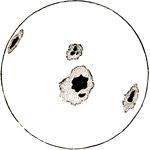 Fig. 23.
The sun turns on his own axis once in a little more than twenty-five days. This fact is known by observing certain dark places seen by the telescope on the sun's disk, called solar spots. These are very variable in size and number. Sometimes, the sun's disk, when viewed with a telescope, is quite free from spots, while at other times we may see a dozen or more distinct clusters, each containing a great number of spots, some large and some very minute. Occasionally, a single spot is so large as to be visible to the naked eye, especially when the sun is near the horizon, and the glare[105] of his light is taken off. One measured by Dr. Herschel was no less than fifty thousand miles in diameter. A solar spot usually consists of two parts, the nucleus and the umbra. The nucleus is black, of a very irregular shape, and is subject to great and sudden changes, both in form and size. Spots have sometimes seemed to burst asunder, and to project fragments in different directions. The umbra is a wide margin, of lighter shade, and is often of greater extent than the nucleus. The spots are usually confined to a zone extending across the central regions of the sun, not exceeding sixty degrees in breadth. Fig. 23 exhibits the appearance of the solar spots. As these spots have all a common motion from day to day, across the sun's disk; as they go off at one limb, and, after a certain interval, sometimes come on again on the opposite limb, it is inferred that this apparent motion is imparted to them by an actual revolution of the sun on his own axis. We know that the spots must be in contact, or very nearly so, at least, with the body of the sun, and cannot be bodies revolving around it, which are projected on the solar disk when they are between us and the sun; for, in that case, they would not be so long in view as out of view, as will be evident from inspecting the following diagram. Let S, Fig. 24, page 106, represent the sun, and b a body revolving round it in the orbit a b c; and let E represent the earth, where, of course, the spectator is situated. The body would be seen projected on the sun only while passing from b to c, while, throughout the remainder of its orbit, it would be out of view, whereas no such inequality exists in respect to the two periods.[106]
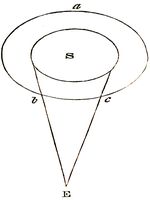 Fig. 24.
If you ask, what is the cause of the solar spots, I can only tell you what different astronomers have supposed respecting them. They attracted the notice of Galileo soon after the invention of the telescope, and he formed an hypothesis respecting their nature. Supposing the sun to consist of a solid body embosomed in a sea of liquid fire, he believed that the spots are composed of black cinders, formed in the interior of the sun by volcanic action, which rise and float on the surface of the fiery sea. The chief objections to this hypothesis are, first, the vast extent of some of the spots, covering, as they do, two thousand millions of square miles, or more,—a space which it is incredible should be filled by lava in so short a time as that in which the spots are sometimes formed; and, secondly, the sudden disappearance which the spots sometimes undergo, a fact which can hardly be accounted for by supposing, as Galileo did, that such a vast accumulation of matter all at once sunk beneath the fiery flood. Moreover, we have many reasons for believing that the spots are depressions below the general surface.
La Lande, an eminent French astronomer of the last century, held that the sun is a solid, opaque body, having its exterior diversified with high mountains and deep valleys, and covered all over with a burning sea of liquid matter. The spots he supposed to be produced by the flux and reflux of this fiery sea, retreating occasionally from the mountains, and exposing to view a portion of the dark body of the sun. But it is inconsistent with the nature of fluids, that a liquid, like the sea supposed,[107] should depart so far from its equilibrium and remain so long fixed, as to lay bare the immense spaces occupied by some of the solar spots.
Dr. Herschel's views respecting the nature and constitution of the sun, embracing an explanation of the solar spots, have, of late years, been very generally received by the astronomical world. This great astronomer, after attentively viewing the surface of the sun, for a long time, with his large telescopes, came to the following conclusions respecting the nature of this luminary. He supposes the sun to be a planetary body like our earth, diversified with mountains and valleys, to which, on account of the magnitude of the sun, he assigns a prodigious extent, some of the mountains being six hundred miles high, and the valleys proportionally deep. He employs in his explanation no volcanic fires, but supposes two separate regions of dense clouds floating in the solar atmosphere, at different distances from the sun. The exterior stratum of clouds he considers as the depository of the sun's light and heat, while the inferior stratum serves as an awning or screen to the body of the sun itself, which thus becomes fitted to be the residence of animals. The proofs offered in support of this hypothesis are chiefly the following: first, that the appearances, as presented to the telescope, are such as accord better with the idea that the fluctuations arise from the motions of clouds, than that they are owing to the agitations of a liquid, which could not depart far enough from its general level to enable us to see its waves at so great a distance, where a line forty miles in length would subtend an angle at the eye of only the tenth part of a second; secondly, that, since clouds are easily dispersed to any extent, the great dimensions which the solar spots occasionally exhibit are more consistent with this than with any other hypothesis; and, finally, that a lower stratum of clouds, similar to those of our atmosphere, was frequently seen by the Doctor, far below the luminous clouds which are the fountains of light and heat.
Such are the views of one who had, it must be ac[108]knowledged, great powers of observation, and means of observation in higher perfection than have ever been enjoyed by any other individual; but, with all deference to such authority, I am compelled to think that the hypothesis is encumbered with very serious objections. Clouds analogous to those of our atmosphere (and the Doctor expressly asserts that his lower stratum of clouds are analogous to ours, and reasons respecting the upper stratum according to the same analogy) cannot exist in hot air; they are tenants only of cold regions. How can they be supposed to exist in the immediate vicinity of a fire so intense, that they are even dissipated by it at the distance of ninety-five millions of miles? Much less can they be supposed to be the depositories of such devouring fire, when any thing in the form of clouds, floating in our atmosphere, is at once scattered and dissolved by the accession of only a few degrees of heat. Nothing, moreover, can be imagined more unfavorable for radiating heat to such a distance, than the light, inconstant matter of which clouds are composed, floating loosely in the solar atmosphere. There is a logical difficulty in the case: it is ascribing to things properties which they are not known to possess; nay, more, which they are known not to possess. From variations of light and shade in objects seen at moderate distances on the earth, we are often deceived in regard to their appearances; and we must distrust the power of an astronomer to decide upon the nature of matter seen at the distance of ninety-five millions of miles.
I think, therefore, we must confess our ignorance of the nature and constitution of the sun; nor can we, as astronomers, obtain much more satisfactory knowledge respecting it than the common apprehension, namely, that it is an immense globe of fire. We have not yet learned what causes are in operation to maintain its undecaying fires; but our confidence in the Divine wisdom and goodness leads us to believe, that those causes are such as will preserve those fires from extinction, and at a nearly uniform degree of intensity. Any ma[109]terial change in this respect would jeopardize the safety of the animal and vegetable kingdoms, which could not exist without the enlivening influence of the solar heat, nor, indeed, were that heat any more or less intense than it is at present.
If we inquire whether the surface of the sun is in a state of actual combustion, like burning fuel, or merely in a state of intense ignition, like a stone heated to redness in a furnace, we shall find it most reasonable to conclude that it is in a state of ignition. If the body of the sun were composed of combustible matter and were actually on fire, the material of the sun would be continually wasting away, while the products of combustion would fill all the vast surrounding regions, and obscure the solar light. But solid bodies may attain a very intense state of ignition, and glow with the most fervent heat, while none of their material is consumed, and no clouds or fumes rise to obscure their brightness, or to impede their further emission of heat. An ignited surface, moreover, is far better adapted than flame to the radiation of heat. Flame, when made to act in contact with the surfaces of solid bodies, heats them rapidly and powerfully; but it sends forth, or radiates, very little heat, compared with solid matter in a high state of ignition. These various considerations render it highly probable to my mind, that the body of the sun is not in a state of actual combustion, but merely in a state of high ignition.
The solar beam consists of a mixture of several different sorts of rays. First, there are the calorific rays, which afford heat, and are entirely distinct from those which afford light, and may be separated from them. Secondly, there are the colorific rays, which give light, consisting of rays of seven distinct colors, namely, violet, indigo, blue, green, yellow, orange, red. These, when separated, as they may be by a glass prism, compose the prismatic spectrum. They appear also in the rainbow. When united again, in due proportions, they constitute white light, as seen in the light of the sun.[110] Thirdly, there are found in the solar beam a class of rays which afford neither heat nor light, but which produce chemical changes in certain bodies exposed to their influence, and hence are called chemical rays. Fourthly, there is still another class, called magnetizing rays, because they are capable of imparting magnetic properties to steel. These different sorts of rays are sent forth from the sun, to the remotest regions of the planetary worlds, invigorating all things by their life-giving influence, and dispelling the darkness that naturally fills all space.
But it was not alone to give heat and light, that the sun was placed in the firmament. By his power of attraction, also, he serves as the great regulator of the planetary motions, bending them continually from the straight line in which they tend to move, and compelling them to circulate around him, each at nearly a uniform distance, and all in perfect harmony. I will hereafter explain to you the manner in which the gravity of the sun thus acts, to control the planetary motions. For the present, let us content ourselves with reflecting upon the wonderful force which the sun must put forth, in order to bend out of their courses, into circular orbits, such a number of planets, some of which are more than a thousand times as large as the earth. Were a ship of war under full sail, and it should be required to turn her aside from her course by a rope attached to her bow, we can easily imagine that it would take a great force to do it, especially were it required that the force should remain stationary and the ship be so constantly diverted from her course, as to be made to go round the force as round a centre. Somewhat similar to this is the action which the sun exerts on each of the planets by some invisible influence, called gravitation. The bodies which he thus turns out of their course, and bends into a circular orbit around himself, are, however, many millions of times as ponderous as the ship, and are moving many thousand times as swiftly.
LETTERS ON ASTRONOMY,
IN WHICH THE ELEMENTS
OF THE SCIENCE ARE
FAMILIARLY EXPLAINED
IN CONNECTION WITH
BIOGRAPHICAL
SKETCHES OF THE MOST
EMINENT ASTRONOMERS.
WITH NUMEROUS
ENGRAVINGS.